Sunday, June 18, 2006


Thank God John Fogerty Is Playing These Songs Again...

DVD Review: John Fogerty-The Long Road Home In Concert

I never saw Creedence Clearwater Revival in concert. I saw most of the other great bands and artists from the sixties era--from Hendrix to Joplin to the Jefferson Airplane. But never Creedence.

And for years it appeared I would never be able to hear great songs like "Who'll Stop The Rain?," "Green River," and "Born On The Bayou" in concert because John Fogerty, the man who wrote all those great songs and scores more over a remarkable four year period from 1968-1972, simply refused to perform them.

You see, Fogerty was at the time embroiled in a series of lawsuits, both with his former CCR bandmates, and his former label Fantasy Records, over the rights to those songs.

So when he decided to once again perform them a few years back, nobody was happier than me. I've seen Fogerty perform them live numerous times since then with various backing bands.

The first time was at the Gorge Ampitheatre on the banks of the Columbia River on a gorgeous August night with a band featuring the great Kenny Aronoff on drums. The one-two punch of "Born On The Bayou" and "Green River" which opened that show gave me chills it was so good.

Then in 2004, I got to see Fogerty backed by the great E Street Band on the Vote For Change tour. The version of "Fortunate Son," one of the greatest antiwar anthems ever, played that night was positively explosive.


Then just last year, I heard Fogerty live with his new band on a double bill with another great American songwriter, John Mellencamp. This was the best of them all. Flanked by a couple of other great guitarists, Bob Britt and Billy Burnette, Fogerty was absolutely in his element on this particular night. As underated a guitarist as there is in all of rock music, Fogerty stretched out his swampy cajun funk that night in gloriously extended jams on songs like "Keep On Chooglin."

The concert captured on this great new DVD was recorded just a few nights later at Los Angeles' Wiltern Theatre with the same band. Simply put, this may just be Fogerty's dream band. The man has never sounded better. Not to disrespect his former CCR bandmates, but these songs played by this crack band sound as fresh here as though they were recorded yesterday.

And they are all here. "Proud Mary," "Bad Moon Rising," "Have You Ever Seen The Rain," "Down On The Corner," and the list just goes on and on.

By today's standards, it is truly remarkable that so many of these great songs were released on four albums over the span of a mere eighteen months from 1968-70.

John Fogerty's credentials as one of America's greatest songwriters are beyond dispute. What is truly amazing about this man is the way his songs were so completely embraced by Top Forty radio at the time, and received in the same way by the public as completely innocent pop singles. This despite the anti-war messages of songs like "Who'll Stop The Rain," and "Fortunate Son."

Fogerty's songs were so damn good from a standpoint of craftsmanship, that the deeper messages contained within were simply overlooked.

Outside of "Like A Rolling Stone" perhaps, even Dylan cannot claim that.

What has often been overlooked however is Fogerty's pedigree as a true guitar original. There is simply nobody who captures the deep, dark cajun swamp feel like John Fogerty does. Tony Joe White came close once with "Polk Salad Annie." But Fogerty nails it like nobody else ever has. On this DVD, he stretches this out to the max in extended versions of chestnuts like "Keep On Chooglin," and "Born On the Bayou."

And he clearly has a great time doing it. One of the coolest moments on this DVD comes when he introduces another of those great songs, "Lodi." Referring to rising gas prices, Fogerty recalls the time he was stranded in a California town because of one of those "en-er-jee-sus-crises."

No, I never saw CCR perform live.

But I doubt very much they could have breathed the same life into these timeless songs, that Fogerty does here with the best damn band he's ever played with.

And he's back on Fantasy Records, the very label he had so many problems with. Thank God John Fogerty is playing these timeless, wonderful songs again. And apparently having the time of his life doing so.

Thursday, June 15, 2006

Music Industry 101 For Artists:
The Press Kit ...


As a former record company weasel, I still get frequently asked by artists about how to distinguish yourself from the rest of the pack when it comes to getting noticed by record companies. So this is a little Music Industry 101 for anyone out there looking to get signed.


The importance of a good press kit cannot be stressed highly enough for any aspiring artist. I am actually going to take that a step further. Not only do you need a press kit, you need one that is going to stand out.

Understand that record companies, club owners, and the like literally get hundreds of these things a week. I've personally sat in A&R (Artist and Repertoire) meetings at record labels where there were boxes and boxes of tapes to go through. So you already know what's next right? Many of them get thrown out, never to be listened to or checked out.

The first ones to go are usually the sloppily packaged, handwritten ones in a plain envelope with a cheap Wal-Mart tape inside. Next are the more standardly packaged, but bland and ordinary-looking ones.

Here is what an average press kit should contain:

A one-page bio: This is your chance to tell your story to the record company big wigs. Emphasize your sound, your history, accomplishments, CD releases, your website, anything that’s an essential part of who you are as an artist. But unless your name is Dr. Dre or Diddy, keep it to one page. Nobody wants to read War and Peace.

Your Artist Photo: A standard black and white or, better yet, a color glossy photo.

Your Music: A CD (cassette tape won't cut it anymore) that can be full length if it is a commercial release, but should be kept to your four best songs tops, if it's a demo. You will need to have attractive eye-catching cover art if you expect to avoid the trash can as well.

A "Fluff Sheet": This is a second page that you can basically have fun with. Make it humorous, make it interesting, but what you are essentially doing is emphasizing bullet points. Keep it short and sweet.


To get past the trash can, you will again need to package this nicely in a folder. Most of all, you want this to stand out in a box full of hundreds of demos going to an A&R meeting.A personal story that I can relate here happened when I was working at Def American Recordings in the nineties.

This group called Decadent Dub Team (DDT) got everybody's attention there by adding a very colorful T-shirt to their press kit (I still own the shirt today) that said "NO WEAK BEATS" on it. On the front it had a picture of Jimmy Swaggart crying. On the back it showed an artist signing a record contract with the devil. Funny shit.

Their tape not only got listened to, but everybody from the mailroom guy to the head of A&R eventually wore one of those shirts. I also saw several L.A. record executives sporting the shirt around town, too, at places like The Troubadour and The Whisky. I don't think they ever got signed. (They weren't that good, to be honest.)

But their tape did get a fair listen. Why? Because they did something to stand out.

When Sir Mix-A-Lot used to come to my record store back when he was just one of many artists trying to get me to listen to his tapes or write about him in The Rocket...he also did something that stood out.

He made a tape for me where he was talking to me by name in a rap. I know it sounds corny now, but the bottom line is he got my attention then and we know the rest of the story...

Finally, where to send your package:

Record companies (specifically A&R, do a little research and get a name, too); club owners; booking agents; radio programmers and Mix DJs; press (magazines like The Stranger, Spin, and anyone else friendly to your cause... this can and should include local newspapers as well); buyers at retail – specifically independents as well as head buyers at chains like Tower (if they even have a main office anymore); key Internet sites (like Blogcritics, and some of the bigger, better read blogs out there) as well as places like Amazon.

Basically you want anyone and everyone who can help you to know who you are. This is how you do it.

Just remember to keep it real, be true to who you are as an artist, and keep things in perspective.

Incidentally, I do bio work...

Wednesday, June 14, 2006


Who Wants Rock Opera? Revisiting Tommy and Quadrophenia

The first thing you need to understand about these two DVD performances is that these are not exactly your typical Who concerts.

At least not if your model of a live Who show is based upon the wild, chaotic performances captured on such classics as The Who Live At Leeds, (possibly the greatest live album ever made) or the DVD The Who Live At The Isle of Wight 1970 (which isn't far behind Leeds in terms of capturing one of rock's greatest live bands on a particularly hot night).

Originally released last fall as a double set, and now split into two seperate DVD's, these rather represent semi-theatrical live performances of The Who's two landmark rock operas by what can only described as an expanded touring ensemble.


If you are looking for the windmilling, guitar smashing Pete Townshend here, you'll likely be disapointed. He rarely plays so much as an electric guitar on either of these DVDs. Roger Daltrey's voice is strong throughout much of the Tommy performance, but is all but gone by Quadrophenia.

The good news is, once you get past the fact that you can't really call this a true Who concert (and has there ever really been one since Keith Moon died anyway?), there's still much to like about both DVDs.

The two concerts here, recorded nearly ten years apart, are basically (as I said) touring theatrical presentations of the rock operas Tommy and Quadrophenia. Then surviving Who members Townshend, Daltrey, and bassist John Entwhistle are joined by an expanded band that more resembles a small orchestra, complete with strings, horns and backup singers. There are also a number of big-name guests who turn in guest performances on several of the songs of each opera.


The idea appears to be one of faithfully recreating the two rock operas down to the last french horn onstage. Taken on that level, the concept works for the most part.

Still, it's hard not to miss the power and chaos of a typically frenetic Who concert.

On the Tommy songs in particular, there is a decidedly watered down feel when you have such commonly viewed reference points as Townshend's windmilling Woodstock performance to measure it against. It even takes two drummers to recreate Keith Moon's drum parts on the Tommy disc.

Still, the music is note for note perfect, and a still relatively young Townshend and Daltrey look and sound energized on this performance recorded at Los Angeles Universal Ampitheatre in 1989. There are also some good backup vocal performances from the big-name guests like Elton John, Steve Winwood, and Billy Idol. Patti Labelle in particular is in top diva form during her turn as The Acid Queen, while Phil Collins is hilarious as Uncle Ernie.

For the Quadrophenia show, recorded when the Who toured the opera in 1996-97, there is a more elaborate stage presentation. Combining original film from the Quadrophenia movie with a newly filmed dramatic narrative with a young Alex Langdon playing the central role of Jimmy, the troubled Mod and central character of Quadrophenia, this is by far the better performance of the two. Despite the fact that The Who members are nearly ten years older--and Daltrey's voice is pretty well shot--the band sounds absolutely outstanding here.

John Entwhistle in particular here is just stunning. Of all The Who albums, Quadrophenia has always been the one where Entwhistle's bass parts we're most dominant, and here he just shreds them to pieces.


The 5.1 audio mix of the DVD showcases his mastery of the four string just beautifully, leaving you to ponder how The Who could possibly carry on without him (the same way Who fans still wonder about Keith Moon). Speaking of Moon, it takes only one drummer to take on that task here and Zak Starkey more than rises to the occasion.

The expanded band is also more effective here taking on Quadrophenia's more symphonic musical sweep. Instrumental passages like "The Rock" are as gorgeous and textured as they are on the original record, and Townshend even swings a few windmills during "Love Reign O'er Me." And Entwhistle's bass on tracks like "The Punk Meets The Godfather" is, as I mentioned, just amazing. Billy Idol is back here as "The Ace Face" for "Sea and Sand" and "Bell Boy." PJ Proby does a humorous vocal turn here as well as "The Godfather" of the storyline's Rockers.


Although Roger Daltrey strains noticably hard to hit those high notes, the music is so strong here it more than covers for the vocal flaws. The Quadrophenia story of a troubled Mod growing up in swinging sixties London is also told more coherently here than it has ever been.


Again the key to appreciating either of these DVDs comes by lowering typical expectations. This is not the controlled mayhem most fans associate with The Who in concert. It does however, represent a faithful, well executed stage recreation of two of that band's most enduring works.

The preceding article was named an "Editors Pick" at http://blogcritics.org for the week ending June 21, 2006

Sunday, June 4, 2006

Jefferson Airplane Loves You (Hot Tuna Does too)

I first saw the Jefferson Airplane live in 1969 at the Civic Auditorium in Honolulu, Hawaii. I was all of thirteen years old at the time and it was the first time my parents allowed me to go to a rock concert all by myself (my Grandmother had actually accompanied me to the few shows I'd attended prior to that).

If only they knew...

The Civic was a mass of stoned humanity that night. The air was thick with the smell of pot. Hippie chicks danced their way through the crowd, many of them topless (a definite bonus for this particularly horny thirteen year old).

Oh yeah, I was all about the half naked dancing hippie chicks.

But more than that, I was absolutely mesmerized by the wild improvising between guitarist Jorma Kaukonen and especially bassist Jack Casady. On record, the Airplane had always been more about the interplay of it's three vocalists--Kantner, Balin, and Slick. Live however, the vocals, at least on that particular night, took a backseat to the extended jamming of it's two best musicians.

Kaukonen's psychedelic staccato leads cut through the air like glass shards. And Casady? In the nearly forty years and hundreds of bands I've seen since, I've rarely seen a bassist play like that. Casady's thick, juicy runs didn't so much support Kaukonen's guitar, as bass players normally do, as it did run great big rumbling circles around it.

All told there was about six hours of music that night. Two from Jorma and Jack's newly formed side project, Hot Tuna, and four more from the classic Airplane lineup of Grace, Marty, Paul, Jorma, Jack, and drummer Spencer Dryden.

That lineup, and the six albums they recorded from 1966-1969 is the focus of The Worst of Jefferson Airplane, originally released in 1970 and just out in a newly remastered version with three bonus tracks from RCA Legacy.

Before splintering off into the numerous messy Starship combinations--Jeffersonian and otherwise--of the seventies and eighties, the classic Airplane lineup were the standard bearers of the psychedelic music revolution born out of San Francisco in the sixties. What this collection reveals anew is how far that lineup progressed musically in just four short years. Each album represented on this collection spotlights a different side of Jefferson Airplane.

From their debut, Jefferson Airplane Takes Off (with soon to be departed original members Signe Anderson and Skip Spence), comes "It's No Secret" and "Blues From An Airplane." Both tracks reveal glimpses of what the band would soon become, especially Balin's R&B vocals on "It's No Secret". But it wasn't until the release of Surrealistic Pillow with the band completed by Dryden and Slick that their full potential was realized. Slick brought two of her own songs, "White Rabbit," and "Somebody To Love" to that record and they would become the band's only legitimate radio hits. Both are included here.


But by that time, Jefferson Airplane didn't really seem to care about radio at all as the band's output grew more experimental musically and political lyrically. The albums After Bathing At Baxters and Crown of Creation saw the band growing by leaps and bounds, with Kaukonen and Casady in particular flexing their musical muscle. The politics were becoming more overt in songs like Grace Slick's "Lather" (which she famously performed in blackface on "The Smothers Brothers Show"), while the powerful combination of Kaukonen and Casady took the music in a harder direction on tracks like "Greasy Heart" and "Watch Her Ride", here for the first time as bonus tracks.

But it is on a live version of "Plastic Fantastic Lover," from the classic live Airplane album Bless Its Pointed Little Head that the Airplane's power as a live band is best showcased. By the time Casady's bass kicks in following the tracks guitar intro, it shakes the song's very foundation. By it's end, Kaukonen's leads are dancing around and around Casady's equally fast runs up and down the fret board. For his part, Balin also turns in one of his best vocal performances here as well.

1969's Volunteers would ultimately prove to be the swansong for the classic Jefferson Airplane lineup. Not surprisingly, it remains their most fully realized work. The songs here are more political than ever, with both the title track and Kantner's "We Can Be Together" (with it's famous rallying cry of "Up Against the Wall Motherfucker"), serving as charged anthems for the by then wiltering flower power generation. But the bluesy sounds that Casady and Kaukonen would later mine with Hot Tuna are also represented here by Kaukonen's "Good Shepherd," a gorgeous reworking of a traditonal spiritual. Jerry Garcia provides steel backup here.

With Jefferson Airplane already splintering at that point, Jorma and Jack began turning their energies to Hot Tuna, the one time side project that by now had become increasingly a full time proposition.

Keep On Truckin': The Very Best of Hot Tuna, clocking in at about 76 minutes, features songs from eight Hot Tuna albums recorded between 1969 and 1978, all chosen by Jorma Kaukonen and Jack Casady themselves. Although various musicians have drifted in and out of Hot Tuna over the years, the focus has always been on Kaukonen and Casady. Likewise, the musical emphasis has always been on the blues that both musicians grew up with.

When Kaukonen and Casady perform as a duo, Kaukonen's finger picking acoustic style on tracks like Rev. Gary Davis "Hesitation Blues" and "Death Don't Have No Mercy" (Davis is the primary influence of that style) sharply contrast Casady's thick electric bass runs, which he plays as frenetically as though there was an entire band there. Another Davis cover, "Candy Man" shows up with an expanded electric lineup that includes violinist Papa John Creach and drummer Sammy Piazza. The musicians stretch out the electric format with another blues cover, this one a nine minute version of Lightnin Hopkins' "Come Back Baby."

But it's not all covers here. Jorma Kaukonen writes many of the originals included here including "True Religion," "I See The Light," and the instrumental "Water Song." Later versions of Hot Tuna would include a second guitar, keyboards, and additional vocalists--a far cry from Hot Tuna's acoustic beginings.

But they never stray far from their roots, coming back to blues covers by Muddy Waters ("I Can't Be Satisfied"), Robert Johnson ("Walkin Blues"), and of course Rev. Gary Davis (a live version of "Keep Your Lamps Trimmed and Burning" produced by Felix Pappalardi of Mountain and Cream fame).

Where Jefferson Airplane is now a distant, hazy psychedelic memory, Hot Tuna, now back to the acoustic duo of Kaukonen and Casady continue to play shows to this day. The legacies of both bands are well represented by these two great collections from RCA Legacy.

Personally I'm a little more partial to the psychedelic improvising of the Airplane (what with the memories of topless hippie chicks dancing through arenas filled with pot smoke and all). Plus the Airplane's songs are a lot more solid. But the blues based Hot Tuna offerings are pretty tasty too. Not to mention the fact that they pretty much laid the groundwork for many of today's "jam bands."

So lets call it an easy five stars for Jefferson Airplane. And a strong three and a half for Hot Tuna.

Sunday, May 28, 2006

A Second Opinion on Reconstructing Radiohead....

Something I read over on Blogcritics caught my eye today.

In his article Thom Yorke is Not an Alien: Deconstructing the Radiohead Conundrum, a writer named Rockbeatstone, whose work I've never come across there before, talked at some length about his experiences discovering the music of Radiohead.

Specifically, he talks in great detail about the records Kid A and Amnesiac.

The reason this piqued my interest is because these are the very two records that were the catalyst for my own conversion from being a fairly casual Radiohead listener to the raving, borderline obsessive fan I would become shortly thereafter.

And make no mistake, I am very much a hardcore Radiohead fan. But much of what I am about to say is probably going to piss a lot of my many fellow Radiohead fans off.

Especially the younger ones. But here goes.

Like pretty much everybody else at the time Kid A was released in the fall of 2000, I owned a copy of it's predecessor, OK Computer.

On the other hand however, unlike pretty much everybody else at the time, I did not buy into the massive critical praise heaped upon OK Computer three years prior.

I still don't, to be perfectly honest.

Did I buy OK Computer based upon those great reviews it had received?

Of course. Again, just like everybody else did.
But to my ears, OK Computer is the same record now that it was then. Which is to say, its a very decent progressive rock album filled with great songs like "Karma Police," "Paranoid Android," and "No Surprises." But groundbreaking? In the same league as Dark Side of the Moon or Pet Sounds as so many continue to insist today?

Hardly.

OK Computer sounded great at the time, and it still does today. But as far as what is actually there on the record itself musically? The truth is, the spacey interludes and frenetic time signatures actually owe more than a little to seventies progressive rock bands like Robert Fripp's King Crimson.

What OK Computer actually succeeded in doing is pulling off what amounts to a musical parlor trick. The sleight of hand involved here is simple. By reviving a few long forgotten moves from the seventies prog-rock playbook, Radiohead ends up sounding remarkably fresh and innovative today.

At least that is unless you count all of the bands trying to duplicate Nirvana's breakthrough at the time.

Can you say Silverchair? Nope. Me neither. Bush? Well I will certainly give props to the bundle of joy that Gavin and Gwen welcomed into the world yesterday.

To a generation who have never heard lesser known bands that were ignored then by the FM rock radio of the day, just as they continue to be ignored today by classic rock formats serving up a steady stream of Zeppelin and Skynyrd, it all sounds quite new.

But those swirling mellotrons you hear on OK Computer? Look no further than Genesis when Peter Gabriel was at the helm, long before Phil Collins ruined them. Hell, for that matter look no further than Hawkwind or even perennial seventies critical losers Uriah Heep.

Which brings us to Kid A and Amnesiac. These are, without question, two very difficult records to digest for many listeners. They are probably especially tough for Radiohead fans weaned on The Bends and OK Computer . It is on an initial listen challenging music to say the least.

Yet they remain my favorites in the entire Radiohead catalog to this day.

The author of the Blogcritics piece which inspired this response talks intelligently, passionately, and in great detail about how it took months (and even years in the case of Amnesiac) to come around to those records. Reading the article is almost painful at times, as it seems the writer is struggling to find a song somewhere amid the computerized whirs, clicks, and beeps that constitute much of Kid A.

In fairness to that writer, to someone whose life was changed by OK Computer (as this author says his was by the article's fourth paragraph), Kid A was probably a pretty bitter pill to swallow. For many of Radiohead's earliest fans, it probably still is. I empathize with that. I really do.

But as for me, I had no problem getting past the lack of recognizable guitar parts described in Rockbeatstone's article in his initial appraisal of Kid A.

On the surface, there is no mistaking the cool, icy vibe that permeates much of Kid A in songs like "Idioteque" and the title track. But as with the debt owed to seventies prog-rock by OK Computer, there was, and is, a clear reference point here. The stripped down minimalism of Kid A has its roots in everything from techno pioneers Kraftwerk to the infamous Bowie/Eno "Berlin Trilogy" of Low, Heroes, and Lodger.

If one starts with the basic assertion that every single rock and roll record that has been made since Chuck Berry is basically a reconstruction of that original three chord progression, a significant argument could even be made for Kid A owing something of a debt to some very early classic hip hop.

Records like Public Enemy's It Takes A Nation Of Millions To Hold Us Back, Beastie Boys Paul's Boutique, and especially De La Soul's Three Feet High And Rising, are nothing if not marvels of the art of deconstructing music to create something uniquely new. Kid A is a perfect example of that sort of music coming from a slightly different kitchen.

Once you get past the icy computerized shock of Kid A, there are plenty of other diverse musical fields to be mined. From the thundering bass powering the dissonant radio broadcasts of "The National Anthem," to the pastoral keys and looped vocals (theres that Robert Fripp influence again) of "Everything In Its Right Place." In many ways, Kid A is actually every bit the groundbreaking marvel that OK Computer is touted by the majority of critics and fans to be.

By the time Amnesiac was released the following year, I actually had the somewhat unfair disadvantage of seeing them perform many of those songs live. The songs of Kid A already had nearly a year's worth of time to grow on me by the time I saw Radiohead for the first time live. That was in the summer of 2001, at the beautiful setting of the Gorge Ampitheatre nestled high atop the banks of Washington State's Columbia River.

During the three hour drive over from Seattle to the Gorge, we also listened to a great soundboard recording a friend brought along from one of Radiohead's shows the previous year in Europe. In addition to the songs from Kid A, the show also included much of what was to become Amnesiac. As that friend will attest, I drove him crazy the entire way begging him to let me burn the CD.

Listening to that CD on the way to the show, what I was most struck by was how much warmer the songs sounded in a live setting. Where songs like "The National Anthem" just outright rocked you right outta your chair with thundering bass, a so-called minor track
like "Morning Bell" built from the quiet pastoral beginings of the recorded version to a powerful crescendo driven by Jonny Greenwood's screaming guitar pyrotechnics.

But I have to say that the point I was sent pretty much sent straight over the edge was when I actually saw the band perform at the Gorge on that starry August night. For me, that show was nothing short of the moment where everything about why this band has built the considerable reputation it has finally became crystal clear to me. It was an absolute revelation, comparable in some ways to the impact I had the time I first saw Bruce Springsteen and the E Street Band live back in the seventies. Just amazing.

For anyone, and especially anyone who considers themselves a fan of Radiohead, I cannot stress highly enough the need to see this band live in order to completely "get it." They are only playing a handful of shows this summer. I'll be travelling to San Francisco to see them next month. But for those who aren't able to get to any of those shows, I've assembled a stream of several live clips which can be viewed by going here

Or you can view the stream by clicking on the play button directly below. If the entire stream doesn't play through (and it is a lot of clips), use the arrows on the right hand side to find the clips you want:


In addition to a number of rare live clips you can pick and choose from the 2001 and 2003 tours here, there are also several clips from a show featuring brand new material recorded at a show in Europe earlier this month.

Anyway, by the time Amnesiac was released later in 2001, I already knew several of the songs from the live show. At the time, the record represented to me the far warmer flip side of the icy cool that was Kid A. That feeling has only grown in the years which have passed since.

I should add that there is also a decided jazzy feel to much of Amnesiac. From the dark, moody bassline which anchors the orchestral ebb and flow of "Dollars and Cents," to the Allman Brothers meets George Benson breeziness of "Knives Out," Amnesiac has a very smooth feel to it in it's own sort of way.

One thing I haven't talked much about in this article are Radiohead's lyrics. That is because to me at least, Radiohead have always been a band that is far more about what is being said in the various moods evoked through the music, then anything being said in the lyrics themselves.

And I have to be completely honest here. Lyrics such as "Yesterday morning I woke up sucking a lemon," looped endlessly as they are in "Everything In It's Right Place," can be pretty nonsensical taken on the surface. But when they are sung in that haunting, otherworldly cry that is Thom Yorke's voice, they make perfect sense.

They make all the sense in the world.

Saturday, May 20, 2006

It Really Is Good To See You Again Alice Cooper

Let's face it. Alice Cooper has been about as far off the musical map as you can get since about 1976 or so.

But for me, "The Coop", as many of his fans called him back then, was a defining influence on my life.

I first discovered Alice as a teenager in the seventies. If it is your high school years that define who you will become in your adult life, the fact that Alice Cooper was my adolescent hero probably explains a lot.

You see, I discovered Alice completely by accident. I was 15 years old and had bought tickets to see The James Gang (Joe Walsh's first band) at the Paramount when word came down that they had cancelled the show. My options at the time we're either get my money back or exchange the tickets for another show. It just so happened that Alice Cooper was playing Seattle a few weeks later as part of the "Killer" tour.

To a lot of my rocker pals at the time, the fact that the guy's name was Alice was enough to convince them to stay far away.

Not me.

The only thing I really knew about Alice back then was that "I'm Eighteen" was a pretty damn decent rock tune, and that according to Circus Magazine he was known to rip up live chickens onstage.

Freak Show? Hell, yeah, at fifteen I was most definitely in.

For the next two years after seeing Alice Cooper that night--basically my entire time in high school--I listened to Alice Cooper every single day.

Although everybody from Kiss back then to Marilyn Manson now would basically devote entire careers to stealing his act, what I witnessed on the Killer tour that night was like nothing I had ever seen before.

The part that I was completely unprepared for--the staged hanging during the "Dead Babies/Killer" show finale--actually scared the crap out of me. The fact that I was high at the time probably was a factor.

But for a minute I actually thought Alice Cooper was dead. That he had actually "suicided right on the stage", no doubt inspiring that line from a Rolling Stones song released a few years later.

When he reappeared for the "Desperado" encore in white top hat and tails tossing money from the end of a sword to the crowd, there was absolutely no doubt in my fifteen year old mind:

This was the coolest guy alive.

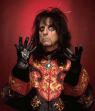
That's a picture of me and Alice up above by the way. It was taken back in the eighties. I was in my early thirities when I finally was able to meet my adolescent hero once I had made somewhat of a name for myself in the music business.

By that time, Alice's glory days we're long behind him. Sure, he still had the occasional hit. I think Alice's last big single was "Poison" in 1989. But his days as the biggest concert draw in the world we're pretty much over once he disbanded the original Alice Cooper Group a couple of years after the landmark Billion Dollar Babies album and tour.

Late last year, a DVD from that tour resurfaced. "It's Good To See You Again Alice Cooper" was a film document of that tour that enjoyed a brief run playing the midnight movie curcuit in the seventies before disapearing into nearly three decades of obscurity. The restored DVD reveals a couple of things. One, is that the old Alice Cooper Band was a gas to watch live. But also, that they basically could barely play their instruments (although I will give props to Neal Smith who was a magnificent double bass drummer). The other thing this DVD brings to light though, is that Alice himself was apparently so drunk most of the time that it's a wonder he made it through those years alive.

Even so, his performance is absolutely riveting. And you really start to appreciate the impact Alice Cooper really had on future generations in terms of rock and roll stagecraft. The show is an absolute spectacle for it's time, with it's huge lighting towers, it's giant dancing toothbrushes, and of course it's guillotine. And Alice's apparent inebriation actually plays very effectively into his onstage character as he staggers about sneering at his audience and rubbing various props about his crotch area.

It's part of what made Alice...well, Alice.

Fast forward to 2006. Alice Cooper may no longer be selling out the Madison Square Gardens of the world, but he is still very much alive and kicking. In fact, Alice Cooper, once the poster boy for every parent's worst nightmare in the seventies, has become downright respectable. On his brand new DVD, recorded live last year at the Montreux Jazz Festival of all places, Alice Cooper is still doing very much the same theatrical shock rock spectacle he has always done.

But this is a stripped down model compared to the extravaganzas of the seventies. It's also very much a G-Rated version. Happily married (Alice's daughter actually plays several roles in the stageshow), and clean and sober for several years now, you won't find Alice grabbing his crotch or uttering so much as a dirty word in this new show. It's amazing what a few years of sobriety will do for a former raging alcoholic mega rock star.

What's amazing about this...aside from just how healthy Alice looks these days...is how much better he sounds. Fronting a band of young hot shots half his age that probably grew up listening to a lot of the songs they perform on this DVD, Alice looks like he could be a brother to these guys rather than their old man. His voice, always one of the great classic rock voices for my money anyway, has simply never sounded stronger.

For the menacing stage persona he perfected so many years ago, Alice no longer has to get by on charisma alone. Here, he prowls, rather than staggers, across the stage taking absolute command of every inch of it. With a razor sharp band that is as tight a unit as he has ever fronted, Alice Cooper rocks with the energy and intensity of a man thirty years younger than he actually is.

As I said, the theatrics are somewhat toned down. But this is after all, still Alice Cooper we're talking about here. He still gets the strait jacket treatment for "Ballad Of Dwight Frye", which he again sings as strongly as he did back in the Love It To Death Days. And of course he still gets the guillotine...still one of the coolest special effects stunts ever done on a concert stage...for the double shot of "Killer" and "I Love The Dead." The show is dotted with other classics from the considerable Cooper canon. "I'm Eighteen," "Schools Out," "Be My Lover," "Under My Wheels," and of course "Billion Dollar Babies" are all here.

As for the newer songs featured here? Well to be honest, there isn't anything here that is going to stick in my brain the way "I'm Eighteen" did the first time I heard it.

But I have to give Alice Cooper credit. He is still mining pretty much the same territory of teenage angst and rebellion that he did back in his heyday on the newer songs from recent albums like last years Dirty Diamonds. The difference is he is doing so with the benefit of wisdom that comes with both age and surviving more demons than either you or I would care to see in a single lifetime.

There's just something about Alice Cooper you gotta love. Even when he was battling those very demons and selling out the biggest arenas in the world, you always knew that deep down he was pretty much your basic All American God fearing Christian sort of good guy.

At least if you we're really listening.

So it really is good to see you again Alice Cooper.

Clean and Sober. Alive and Well. And doing your thing with an energy and vitality that would make most guys half your age positively green with jealous envy.

Wednesday, May 3, 2006

Living With War: Our Review of Neil Young's Incendiary New Protest Album


The new Neil Young album Living With War has created a firestorm of controversy...and it isn't even in record stores yet. The latest word on that seems to suggest a soft release date of May 8, which would put the CD in stores this Monday...although most retail outlets adhere to Tuesday street dates as a rule.


In any event...and for those of you who can't wait...the good news is the album has been available to listen to for free in streaming format at a number of places on the Internet since last Friday.

To listen to Neil Young's Living With War in it's entirety right now, go here

Controversy over the lyrical content aside...and we promise to get to that in a minute...Living With War is pretty much your standard, cranked to eleven, grungy Neil Young album. Although the actual sound harkens back to classics like Rust Never Sleeps and Ragged Glory, Crazy Horse...the band who usually back Neil on these types of records...are nowhere to be found here.

Instead, Living With War was recorded with a core group of musicians consisting of Young himself on electric guitar, vocals and harmonica; Chad Cromwell on drums; and Rick Rosas on bass. They are occasionally joined by Tommy Bray on trumpet (most notably on the title track and "Shock and Awe"), and a 100-member choir (on "Lets Impeach The President" and the beautiful, hymn like version of "America The Beautiful" which closes the album).

As a result, Living With War is not only the loudest album Neil Young has done since he was backed by Pearl Jam on Mirror Ball, it is also the tightest.

The long extended jams of those records with Crazy Horse, are replaced here by ten shorter, more direct songs that get directly to the point. But make no mistake, the volume is cranked all the way up...and Neil's trademark guitar noise with the ever trusty Ol' Black is dead front and center.

While nothing leaps right out here in the same way as Neil Young and Crazy Horse classics "Like A Hurricane" or "Cortez The Killer" for example...well nothing outside of lyrics calling for Bush's impeachment anyway...the shorter, more economical approach allows these songs more room to grow on you.

And with lyrics like "Lets Impeach The President for lying", these songs also pack the far more direct punch that Neil Young clearly intended.

"Lets Impeach The President" of course has drawn the most attention thus far. Neil Young basically rattles off a litany of reasons calling for Bush's ouster from office ranging from the aforementioned "lying...misleading our country into war" to "highjacking our religion...and using it to get elected." The song itself... basically a faster, more uptempo rewrite of "Powderfinger" (you can practically interchange the line "Lets Impeach The President for Lyin" for "Shelter Me from the Powder and the Finger")...ends with Neil's biting off lyrics exchanged with a series of Bush sound bites, as the trumpet plays a melody that sounds like something from a Clint Eastwood spaghetti western.

On "Shock And Awe", Neil's snarling guitar trades off with the almost military funeral procession sounds of the trumpet as he recalls "back in the days of mission accomplished" and prior times "when we had a chance to change our mind."

On "Flags of Freedom', the chorus is sung almost as a companion piece to another famous protest song with a patriotic twist, Bob Dylan's "Chimes of Freedom." He even name drops Dylan in the lyrics between a chorus which celebrates "these flags of freedom flying," even as it questions the wisdom of sending a family's kids off to war. It's a great touch.

On "Looking For A Leader", Young yearns for "someone who walks among us and I hope he hears the call", then rattles off a list of candidates including prominent black politicians like Obama and Colin Powell because "...maybe it's a woman or a black man after all."

The album closes with "Roger and Out", which returns Neil Young to "that old hippie highway" he has repeatedly revisited throughout his career in an obligatory moment of nostalgia and reflection that recalls more pensive mid-seventies work like "On The Beach". Here, he seems to be saying "Roger And Out" to a fallen comrade. This is followed appropriately enough by the choir's solemn, reverent, and gorgeous intonation of "America The Beautiful."

While it would be easy to use the unabashedly critical of the Bush administration lyrics on Living With War, as a flashpoint for debate...indeed, many in the media are already doing just that...it's an argument where ultimately nobody wins.

Some are going to agree with every word Neil Young says on this album, while others are going to lead the charge to ship him back to his native Canada.

Neil Young himself put it this way in a recent interview describing why he decided to make Living With War

"...this is about exchanging ideas... it's about getting a message out. It's about empowering people by giving them a voice. I know not everyone believes what I say is what they think. But like I said before.. ya know.. red and blue is not black and white. We're all together. It's a record about unification." -Neil Young (4/18/06)

For that reason alone, at a time when America is divided by political and cultural ideology like it has probably not been at any time since the Nixon years, it can be reasonably argued that voices of protest and dissent like Neil Young's should not only be welcomed...but that they are necessary. If for no other reason then the fact that they remind us of just why soldiers are sent to war to fight for those freedoms we cherish so dearly in the first place.

Like the freedom of speech that guarantees, among other things, the right to protest or dissent...whether in song or otherwise.

Protest music is as richly American an artform as you'll find anywhere on the landscape of our country's history...from the protest songs born in the dust bowls and the union struggles, to the negro spirituals which arose from the cotton fields of the civil war era.

I personally find it ironic that quite often the loudest voices at home in support of unpopular wars...like Vietnam in the sixties or Iraq in the present day...have also been among the quickest to want to supress the very voices of protest or dissent that the soldiers are supposed to be fighting for.

Living With War is proof that those voices...which have been somewhat quiet in recent years...are rising once again.

Can I get an "Amen" on that?


Here is the complete track listing for Neil Young's Living With War:

1. After the Garden
2. Living With War
3. The Restless Consumer
4. Shock and Awe
5. Families
6. Flags of Freedom
7. Let's Impeach the President
8. Lookin' for a Leader
9. Roger and Out
10. America the Beautiful


Below you will find links to everything you will need to check out Living With War

You can get the latest news on Living With War, as well as listen to the album and read the lyrics at Neil Young's Official Website

To generate a link to your own website or blog for the Living With War streaming album feed, go here. The pop-up generated by the code here should work with most of the main blog sites, but Blogger would not accept the java script for my own blog. It did however, accept the simple link.

For the latest news and information check on Neil Young's controversial "Folk Metal Protest" album, check out the Living With War Blog here

Our friends at Thrashers Wheat have been covering Neil Young's every move longer and better than just about anybody on the internet, and were among the very first to break the Living With War story.

You can also find Neil Young at My Space Here

Listen to Neil Young's Living With War in it's entirety absolutely free here


Now it's up to you to be the judge.