Saturday, June 20, 2009

Woodstock ... Not Ten, But Forty Years After

As the song goes, by the time they got back to Woodstock, they were half a million strong...

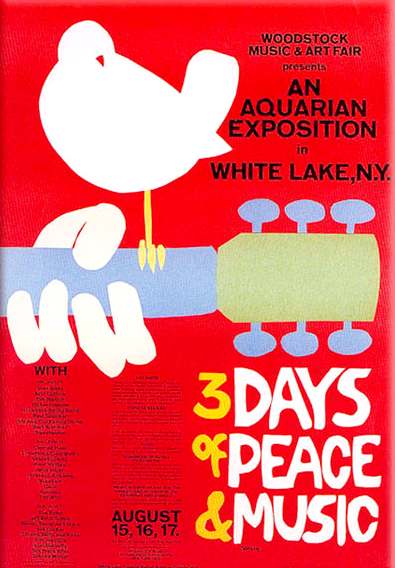
Over the next few weeks and months you're going to start seeing a lot of stuff about Woodstock both on the internet and elsewhere.

That's because the 1969 rock festival -- considered by most music historians and other Rockologist types like yours truly to be the greatest concert of all time -- is turning forty this year.

As the Byrds would say, it seems like only yesterday -- particularly if you were actually around back when it actually happened.

Woodstock is not just the stuff of legend, but also of tall tales told from barstools by aging rockers and other hippie types at the sort of musky watering holes you'll find in most any major city in America. You know the ones that usually start with "I remember Woodstock?"

In my own case, the only thing missing is the grey ponytail.

So, to commemorate this event, there are no less than something like 587 remastered, remixed, and otherwise repackaged Blu-ray, DVD, and CD versions of the concert coming out this summer. Okay, so I'm exaggerating that just a little bit. But not by much.

Remastered versions of the original Woodstock and Woodstock Two soundtrack albums are already in stores on CD now, as is a fresh, new version of the Director's Cut of the original film. The latter item is available both in a single DVD and Blu-ray version, as well as on a full-on boxed set which features loads of previously unseen footage by artists like Creedence Clearwater Revival, Janis Joplin, and the Grateful Dead along with additional unreleased footage from bands like the Who and the Jefferson Airplane.

There's also a brand new interactive website which you'll find by pointing your browser towards Woodstock.com.

Still to come are another boxed set, as well as a series of individual double discs from Sony Legacy capturing the Woodstock Experience with the complete festival performances of Jefferson Airplane, Santana, Sly And The Family Stone, Johnny Winter, and Janis Joplin.

Each of these will also couple the concert recordings with a classic album by each artist from about the same time period. My own reviews on these will be forthcoming here in the days ahead (although I can tell you now that the sound is a bit disappointing on a few of them).

It's all enough to make your world weary Rockologist seek out some of that same famous brown acid for himself. Well almost.

One thing they don't appear to be doing this year -- thankfully -- is another concert.

Although I didn't attend either of them, the last couple of big Woodstock reunion shows (in 1994 and 1999) actually bothered me quite a bit. To me, that sort of legacy is simply something that is not to be screwed with.

I mean did they honestly think they could feature bands like Nine Inch Nails and Metallica playing on some god-forsaken mudpit of a farm out in the middle of upstate nowhere, and not have the fans riot and generally go ape-shit?

Who were they kidding?

This, after all, was not the same group of peaceful, pot smoking hippies decked out in flowers, beads and patchouli oil.

Nor was it artists like mellow sixties lefties Joan Baez, John Sebastian, or for that matter, even Grace Slick inciting the faithful to revolution with the Jefferson Airplane in 1969.

Hell, even if Grace herself were there, had she sang such incendiary lyrics as "Up against the wall, motherfuckers" (as she did back in 1969), you can't help but think that these knuckleheads would have taken it as an invitation to burn down the campground.

As it turns out they didn't need Grace after all, and they did it anyway. It's like, what were they thinking, ya' know?


Anyway, this brings us back to that brand new deluxe boxed set from the original 1969 concert and subsequent film.

The challenge here being, how do you improve upon the perfection of the original without completely screwing it up? In most cases, the answer would be that you don't.

Which is why you've got to give the folks at Warner Video some credit for this set, which is being billed as the "Ultimate Collector's Edition" of Woodstock.

Not that there won't be another one of these things ten or so years down the line, because there probably will.

But for what it's worth, they actually did a pretty nice job here.

Start with the box itself. It comes in a faux leather/suede sort of package, complete with the pre-requisite fringe. Because as anyone who has ever seen the Woodstock film already knows, everyone who was anyone back then -- from Roger Daltrey to David Crosby to Sly Stone -- wore them some fringe. Nice touch, there.

The extras are also pretty cool. You've got your original ticket stubs for starters (eight bucks a day if you can fathom that).

But what I liked best here was the recreation (albeit in a more pocket-sized version) of Life Magazine's original commemorative Woodstock issue. I remember buying this as a thirteen year old boy and cutting out all of the cool pictures of Grace Slick, Sly Stone, and Roger Daltrey and taping them up on my bedroom wall. So for me, that brought back some pretty cool, if slightly bittersweet memories as a thirteen year old, long haired hippie wannabe rock star.

But the real meat of this thing lies in the previously unseen footage of all those great (well, mostly great anyway) musical performances. Not only are some of these added to the original film here (stuff like Janis Joplin for example), but there is also an entire second disc of this stuff.

Sweet.

Nonetheless, much of what you get here is really kind of a mixed bag.

Given the fact that the movie producers had to edit down three days of the world's greatest bands doing their thing into a three hour movie, you can see why bands like Mountain for example, with all due respect, didn't make the final cut.

If I'm being one hundred percent honest here, I also could have probably lived without the nearly half hour or so devoted here to the Grateful Dead doing "Turn On Your Love Light," -- Pigpen (God rest his soul) and all.

In fairness though, Dead fans will probably dig this a lot.

Not so Creedence Clearwater Revival however. John Fogerty and company simply play their asses off here on songs like "Born On The Bayou" and particularly "Keep On Chooglin'," where Doug Clifford beats the living crap out of his drums (did you get that Doug? -- the former CCR drummer has been known to e-mail me on occasion).

Watching this, you gotta' wonder if CCR wouldn't have made it even bigger than they eventually did anyway had "Chooglin'" been included in the original film. The Johnny Winter spot also kicks several degrees of blues slide guitar ass.

The new additions made to the film itself are a bit more curious.

In a particular "WTF" moment, Jefferson Airplane's set doesn't even include the incendiary Woodstock version of their protest anthem "Volunteers," opting somewhat oddly instead for the lower key "Won't You Try/Saturday Afternoon." Still, you gotta love those closeup shots of Grace Slick (love those eyes) and the always amazing Jack Casady (love those eyebrows, and really love that bass, Jack).

It's also great to see Janis Joplin's Woodstock performance on screen at long last. The one time I saw Janis in concert -- as a wide-eyed thirteen year old kid just a few months before she died -- I also got to meet her. I can remember asking her then why she wasn't in the movie. Taking a deep swig of her signature Southern Comfort, Janis replied "probably 'cause I didn't do the editing." She looks and sounds great here, belting out a nice version of "Work Me, Lord."

Some of the other nice additions to the original film here include Jimi Hendrix doing "Voodoo Child" and the Who doing "Summertime Blues" and "My Generation" (well okay, that one's on the bonus disc).

Personally, I'd have loved to have seen or even heard the way Townshend famously told sixties radical Abbie Hoffman to "get off my fucking stage" with his boots here. But as the Stones would say, I guess ya' can't always get what you want.

Outside of all the extras here, the rest of the Woodstock film is pretty much the same as I've remembered for some forty years now. The career making performances from Santana, Ten Years After, and the rest remain as great now as they were back then.

However, Sly And the Family Stone's performance still stands in a class entirely its own. In fact, if I have any beef at all with this box, it is with the strange editing and even stranger sound drop-offs here of that very same performance.

As I said from the onset of this article, you just don't fuck with that kind of greatness.

Over the next few days, I will be reviewing Sony/Legacy's Woodstock Experience CDs from Sly, Santana, Janis, the Airplane, and Johnny Winter.

In the meantime, happy 40th birthday Woodstock.

Saturday, June 13, 2009

King Of The Blues And King Of Montreux 1993

Music DVD Review: BB King -
Live At Montreux 1993

Although I've always admired him greatly as the perhaps the singular greatest bluesman of this -- or any other -- generation, it took me years before I actually witnessed the great BB King in concert.

Once I finally did, about ten years ago at an outdoor concert in the picturesque setting of Washington State's Gorge Amphitheatre overlooking the Columbia River -- I couldn't help but feel I'd still missed something. Allow me to explain.

You see, the venerable blues great still looked and sounded as good as ever, despite his obviously advancing age. But he also played most of the show sitting down, which at least for me was a telling point. It made me regret all the more the numerous opportunities I'd had to see him as a much younger, more vital man in his prime.

This was after all the man who had such a singular influence on most, if not all, of the great British rock guitarists I'd grown up worshiping as a young music fan -- from Clapton to Hendrix to Page.

Younger? More Vital? Shit, let's be honest here. BB King simply does not age like we mortal men do.

If Robert Johnson once danced with the devil at the crossroads, then most surely BB King must have drank from the fountain of youth somewhere between New Orleans and the Mississippi Delta. Because as it turns out, the man may get older. But he does not age.

And on this DVD, the king of the blues is also apparently the king of the Montreux Jazz Festival. BB King has played Montreux something like twenty times, and thanks to the folks at Eagle Rock one of the very best of these performances has been captured for posterity on the new DVD BB King Live At Montreux 1993. And as is always the case with Eagle Rock's Montreux DVDs, both the picture and sound are top shelf here.

One of the things I love about blues concerts like this one, is the way that they capture the long lost art of the old time rhythm and blues revue. When I saw BB at the Gorge, he may have been seated for the majority of the show. But this in no way diminished the pace of the show, the tightness of his band, or most importantly, the flawlessness of King's playing. Regardless of his age, BB King, like the finest of wines, only grows better with age.

On this DVD, King's crack band -- which is more like a small orchestra really -- gets the crowd warmed up for a few numbers, before setting up the appearance of the main event in the form of the man himself, who comes out about three numbers into the show.

The set here is probably not all that much different from the hundreds King plays each year -- and has since approximately the dawn of time.

But the key here is the way the band nonetheless remains as tight as a drum. Not a single cue is missed here -- from the rhythm section all the way down to the razor sharp horns. This is as tight as tight gets.

Seriously, what ever happened to this kind of shit? Because I for one, want it back.

On this DVD, BB King's still amazing after all of these years guitar playing remains the main event, commanding the attention it has so rightfully earned over the years and still deserves.

This is a fairly standard BB King concert, if there even is such a thing. But from "Rock Me Baby" to "Why I Sing The Blues" to Robert Cray's "Playing With my Friends" to the inevitable "The Thrill is Gone," the man quite simply is a walking textbook of blues 101.

Never mind the fact that on this particular performance, BB King shows himself to be such a consummate pro that it might be easy to get the impression he could do this stuff in his sleep. Hell, truth is he probably easily could.

The fact still remains that BB King is the king of the blues, and on this great DVD, he is also the king of Montreux, even if only for this one night. And for me at least, it was great to finally see the grand old man do his thing standing up.

This, my friends, is quite simply how it is done.

Friday, June 12, 2009

Prog-Rock Flashback: Even In Black And White Annie And Renaissance Sound Great

Music DVD Review: Renaissance - Song of Scheherezade (Renaissance Live)

Renaissance was a band who enjoyed a brief run of popularity in the late seventies playing a largely classical piano-based brand of symphonic rock. Although they never quite became Moody Blues huge, they did have a sizable enough cult following to earn them a run at New York's prestigious Carnegie Hall playing with the New York Philharmonic, which was captured on the recently reissued Live At Carnegie Hall album.

While Renaissance's sound was mostly piano-based, the band were all great musicians, and had a particularly amazing bassist in Jon Camp. But the true star of Renaissance was Annie Haslam, a stunning vocalist also rarely gifted with a five octave range.

I can still remember the first time I saw them covering them as a still underage music journalist during a performance at a Seattle nightclub. Standing roughly five feet away from the band, I was rather startled to actually feel the air vibrating in front of me as Annie Haslam sang. It was a truly amazing experience, as she hit notes so high that I've no doubt every dog in the neighborhood could hear them.

Song of Scheherezade captures two Renaissance performances from roughly the same time period -- one from 1976 and the other from 1979. While the music here is as amazing as I remember it, the DVD itself however is far from being perfect. The entire thing is shot in black and white for one thing, and the often grainy visual quality also suffers due to its age.

Taking that into account however, this DVD is far better than it really has any right to be. The sound, while not excellent by modern standards, is surprisingly good -- kind of like about what you'd expect from an upper tier bootleg from the same period. The camera angles also capture some pretty great stuff, particularly when they zero in on Camp's bass playing -- which thankfully they do fairly often.

Not that Renaissance were ever really that visual a band to begin with though. As a frontperson, Annie Haslam could never be mistaken for a dynamic performer in the Janis Joplin or Tina Turner mold. In fact, her onstage persona is a lot more like that of a New-agey sort of fairy princess with her swirling movements and flowing dresses.

But even in glorious black and white, Annie Haslam sounds as amazing as I can remember, especially when hitting those impossibly high notes on songs like "Prologue," "Can You Understand," and "Song Of Scheherezade."

It's just too bad they didn't include her vocal tour de' force on the song "Ashes Are Burning" here. But to see exactly what I'm talking about, you can check out the video below (which is not from this DVD, but rather from a 1983 performance in Chicago).

For Renaissance fans, and for those who can overlook the visual quality here in favor of the historical significance, Song of Scheherezade is something of a must. For the curious and all others, I'd point you toward the re-release of Live At Carnegie Hall.

Tuesday, June 9, 2009

Neil Young American Masters Documentary Airs On PBS Starting June 10

TV Review: PBS American Masters: Neil Young - Don't Be Denied

If you are willing to sit through those ten-minute breaks for their fundraising pitches, some of the best historical rock and roll programming you'll find anywhere on television can regularly be seen in one of the least likely places you might imagine.

The Public Broadcasting Network (PBS) has in fact been running some pretty great stuff lately, including portions of the Eric Clapton/Steve Winwood concert found on the recent Live From Madison Square Garden DVD, and the yet to be released Last Days Of The Fillmore documentary. But the network may have just topped itself with the latest installment of the long-running American Masters series -- a brand new documentary on Neil Young.

Neil Young - Don't Be Denied (which begins airing on PBS stations on June 10 -- check local listings) traces the often idiosyncratic but always iconic career path of the rock legend. It begins with his roots in Winnipeg, Canada, and continues through his stints with Buffalo Springfield, Crosby, Stills, Nash & Young, and Crazy Horse, before winding up with his infamous antiwar themed Living With War album and the subsequent Freedom Of Speech tour with CSN&Y in 2006.

Along the way, the filmmakers miss a few key periods -- no mention is made of the 1989 comeback album Freedom for example -- but they manage to catch a whole lot more. Much of this comes by way of a generous amount of footage taken from the artist's own private collection (much of which, one would have to assume, is also included in the just released career-spanning Archives boxed set). There are also interviews with insiders like Crosby, Stills & Nash, Nils Lofgren, James Taylor, and of course Neil himself.

In interviews with former members of Neil's first band the Squires, they describe the young band's sound as "surf rock instrumentals." Neil then proves this point by playing an original Squires 45 that sounds like something straight out of Shadows territory. "We were better too," Neil's one-time bandmate concludes.

Neil also describes the days when the band hauled their equipment around in an old hearse. "It was made for us," he says, "it had rollers in the back, so you could roll the amps in and out." In another rarely seen clip from Neil's experimental film Human Highway, he jams with Devo on an early version of what eventually became the song "My My, Hey Hey (Into The Black)."

The film also serves as a career examination of Neil Young, through both his commercial peaks (Harvest, Rust Never Sleeps) and more experimental lows (Trans, Everybody"s Rocking). What emerges from this is a portrait of an artist who simply refuses to compromise his artistic muse, even when it means damaging personal relationships or confounding both his record company and his fans.

"I only care about the music," Neil Young explains at one point. "It's sad, because sometimes people get damaged by it."

Neil Young - Don't Be Denied is about as personal and eye-opening a look into the career of this legendary artist as any I've ever seen. Produced for PBS American Masters series by THIRTEEN and WNET.org and directed by Ben Whalley, it premieres on PBS stations on June 10. Check local listings.

Sunday, June 7, 2009

Procol Harum And A Symphony Orchestra? In 2009? You're Kidding, Right?

Music DVD Review: Procol Harum -
In Concert With The Danish National Concert Orchestra And Choir

Rock groups performing with symphony orchestras has always been a bit of a dicey proposition at best. Yet ever since the Beatles began adding such classical orchestration to their records, it has also been the sort of experiment that simply proved too much to resist for some bands.

Predictably, the results have almost always proved disastrous (there's good reason why few people remember Deep Purple's attempt for example). On the other hand, there have been a handful of groups who were actually able to pull it off, most notably the Moody Blues.

Procol Harum is one such band. In fact their second biggest hit song "Conquistador," (the biggest of course being the sixties psychedelic classic "A Whiter Shade Of Pale") came from just such a recording, a 1974 live album made with the Edmonton Symphony Orchestra.

Thirty years after that album, Procol Harum are at it again on In Concert With The Danish National Concert Orchestra And Choir, a new DVD filmed at an outdoor concert in Denmark under the picturesque setting of a Danish Castle.

Procol Harum and a symphony orchestra. Like that surprises you?

I for one was surprised to see that Procol Harum was even still together. That initial surprise was however quickly explained away watching this DVD as it became apparent that today's Procol Harum consists of original singer/songwriter/keyboardist Gary Brooker and a group of very good musicians, none of which I remember from the band as I knew them in their sixties and seventies heyday.

Of course Procol Harum was always kind of a revolving door that way. Previous members include one-time seventies guitar hero Robin Trower.

So this DVD is pretty much what I expected. Both the sound and the video are excellent as concert videos from the folks at Eagle Rock nearly always are. Gary Brooker, looking every bit like the perfect graying english gentleman these days, has also managed to maintain his voice quite well.

As for the songs?

Also pretty much what I expected. Some work great within the more classical format, while others don't work quite as well. The orchestral arrangement on "A Salty Dog" for example really does compliment the original, particularly in the case of the added choral touches. "Conquistador" is likewise flawless, but of course that song already benefited from the orchestral arrangement that made the song such a big hit back in the seventies.

Less successful is the symphonic arrangement of "A Whiter Shade Of Pale." If there was ever a song where you don't want to de-emphasize the organ (or to try adding to it), that's the one. It's like screwing with "Light My Fire." You just don't do it.

Likewise, "Simple Sister," a guitar powered near-hit for Procol Harum from the Trower days is done no favors by a female choir singing the words "Simple Sister" at exactly the moments where the guitar should be out front and center.

The bonus material here is pretty danged cool though -- a six song set filmed for a Danish TV special in 1974 that actually reminds you these guys knew how to rock at one time. And that people could actually smoke in a bar way back then.

Saturday, June 6, 2009

Moody Blues: Strike Up The Bong

Music DVD Review: The Moody Blues -
Threshold Of A Dream: Live At The Isle of Wight Festival 1970

Somewhere in between hearing my first choir-backed chorus on a heavy metal song by Uriah Heep (on the album Demons And Wizards), and delving head first into the mellotron drenched prog-rock of seventies bands like the Strawbs and Genesis, I discovered -- and briefly at least -- became quite fond of the symphonic rock of the Moody Blues.

In many ways for me, the Moodies acted as the bridge between the metal and glam rock of my high school years, and the full-on prog I found myself briefly immersed in as a college student. Punk Rock, New Wave, and Rap were still to come on my eventual road to discovering Bruce Springsteen. But I digress...

Although the Moody Blues are probably best known for the numerous recordings they have made with symphony orchestras and the like, their keyboard player Mike Pinder could make quite a substantial noise all by himself with the simulated strings and voices he employed on the mellotron.

Primary songwriters Justin Hayward and John Lodge provided an ample canvas for Pinder to fill in the colors with in the form of their lushly romantic pop songs of course. But for those in the know, Pinder was always this band's secret weapon.

Of course, there was also the none too small matter of the Moody Blues often unintentionally living up to their reputation of being quite possibly the most pretentious band on the planet to consider.

Between their new-agey transcendental meditation inspired lyrics (long after the Beatles had given up such nonsense), and Graeme Edge's oh-so-seriously spoken word intros on Moody Blues albums inviting listeners to "breathe deep" or to ponder words like "I think...therefore I am...I think," this was more than enough to scare off a lot of rock fans who just wanted to, well you know, rock out.

Legitimate gripe that this was, and still is, for the purposes of this review I prefer to remember the better things about this band.

Like sitting in my one bedroom apartment on any given Friday night where I couldn't find a date (which was far more often than I'd like to admit), and turning the lights down low, firing up the bong, and putting on an album like say, To Our Childrens Childrens Children and pondering the true meaning of this band's oh-so-deep music.

Yeah, that's it.

And on that note, Threshold Of A Dream: Live At The Isle of Wight Festival 1970 does an excellent job of not only taking me right back there, but making me forget that I ever finally outgrew this nonsense.

Well okay, not all of it was nonsense. And I've also got to admit that not only do a lot of these Moody Blues songs hold up surprisingly well -- but in the case of stuff like "Gypsy" and "Question," that the Moodies also actually kinda' rocked.

In fact on this DVD, recorded at England's 1970 Isle of Wight rock festival (the same one where an explosive performance by the Who was likewise captured for eternal DVD posterity), the Moodies even manage to rock out on such otherwise sanguine songs as "Tuesday Afternoon." Drummer Graeme Edge in particular powers these songs a lot more than I ever can remember him doing.

Captured by veteran rock documentarian Murray Lerner -- who has also made great rock films about Bob Dylan among others -- Live At The Isle of Wight Festival 1970 captures a moment in time, and a band who has been perhaps too often been unfairly maligned, at their creative and commercial peak.

Interspersed with the concert footage are present day interviews with the Moody Blues (and you don't know how tempted I was to say "surviving members," because amazingly in this case, they all actually have). Given the dated nature of the material, both the video and audio are also surprisingly good here. There is also footage of the Moodies back when they were a scrapping young band (including soon to be McCartney's Wingman Denny Laine) covering Bo Diddley songs (hence, the "blues" part of their moniker).

The set itself is pretty short, but the Moodies cover it quite well within the time alloted them. Hits like "Nights In White Satin" and "Tuesday Afternoon," captured while they were still relatively new, sound as fresh now as they did then -- and Mike Pinder's mellotron more than makes up for the lack of the London Symphony or whoever.

Again though, the real revelation here is that despite their reputation for pretentious mystical noodle-gazing, the Moody Blues actually kind of rocked.

Now excuse me, while I go look for that old bong...

Wednesday, June 3, 2009

CSN's dEMOS (Their Spelling, Not Ours) Compliments Neil Young's Box Nicely

Music Review: Crosby Stills & Nash - dEMOS

With all of the attention being paid to Neil Young's Archives set this week -- mainly because it's so hard to believe he finally put the damn thing out -- you'd be easily forgiven for missing the fact that his sometime bandmates in Crosby Stills & Nash also have their own new retrospective package out.

Though nowhere near as extensive as Archives, the more modest -- and moderately priced -- dEMOS (their spelling, not ours) makes a fine little compliment to Neil's far bigger deal collection. dEMOS comes exactly as advertised by its title, pulling together twelve demo recordings of songs made famous by various combinations of the three principals.

One interesting point here however, is the fact that on only one track, an acoustic demo of Nash's "Marrakesh Express," do all three members of CSN appear together. This leaves the listener with the distinct impression that these songs truly are the actual demos, as they were brought to various album projects by the individual members themselves.

What this also means, is that you not only get demos for the collective CSN albums, but for the various solo efforts of each of these musicians. Most of these prove interesting enough, although the results themselves prove something of a mixed bag. On Graham Nash's demo for his solo hit "Chicago" for instance, both Nash's vocal (even without a backing choir of female voices) and the signature piano melody remain so distinct you can barely tell the difference between this version and the more familiar one.

Stephen Stills solo demo for "Love The One You're With" likewise maintains the same feel as the original, although it's played quite a bit looser here. More interesting is a version of "Music Is Love," that was originally recorded for David Crosby's overlooked 1971 solo album If I Could Only Remember My Name. Joined by Neil Young, Crosby and Stills' harmonies on this song are fairly remarkable here, even without any overdubs. The addition of Young makes them even stronger.

Crosby's songs for CSN are likewise well represented here. Although his deeper vocal timbre is noticeably missed on solo acoustic versions of "Deja Vu" and "Almost Cut My Hair," it is equally at the forefront of the demo for "Long Time Gone." On the latter, Crosby is also joined by a slightly busy, but surprisingly decent sounding Stephen Stills on drums.

Produced by Graham Nash -- presumably around the same time he was putting together his own Reflections anthology box -- dEMOS is a decent, if not quite essential collection sure to please CSN's many fans. It also makes a nice companion to the Neil Young box.