Neil Young Knockoff Roc-Doc Is Saved From Dullsville By Its Soundtrack
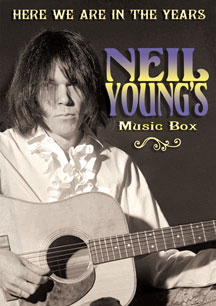
DVD Review: Here We Are In The Years: Neil Young's Music Box
With a fresh crop of new Neil Young releases arriving in stores this month — including the MusiCares Tribute To Neil Young DVD collection and the 1985 concert recording A Treasure with the International Harvesters — this knockoff, straight-to-DVD style documentary is likely to get lost in the shuffle.
Even so, Here We Are In The Years: Neil Young's Music Box is not without its merits.
Like most similarly unauthorized rock documentaries, Here We Are In The Years was made without the participation or endorsement of its subject, and features a round table of music writers and other geeky types offering up their critical assessments of the artists work. If you've ever come across any of those cheesy classic rock DVDs with titles like "A Critical Review" in the bargain section of your local music store — or worse yet, ever watched one — this will give you a pretty good idea of what to expect.
What sets Here We Are In The Years: Neil Young's Music Box apart from the pack however, is its unique focus on a central theme — in this case, Neil Young's musical influences, from surf and folk to punk and grunge. But what really saves this from being another ninety dull minutes on the couch with a bunch of annoying critics is the soundtrack.
The film makes generous use of Young's music, including some fairly choice video performance clips. Drawn mainly from common sources like the Rust Never Sleeps film, many of these will of course already be familiar to Neil Young fans. But if you watch close enough, you'll see that some are of a much rarer vintage.
In discussing Neil Young's musical influences, the film often uses his own songs to punctuate the comparisons. When discussing folk guitarist Bert Jansch for example, the soundtrack features the great On The Beach track, "Ambulance Blues" (Young once claimed to have stolen the acoustic guitar melody from Jansch).
In another scene dealing with the Rolling Stones influence, Young's "Borrowed Tune" (the title refers to his own borrowed use of the Stones' "Lady Jane"), is given equally clever use. Scenes devoted to the impact of Kraftwerk on Young's underrated 1983 Trans album, split footage from the now rare Live In Berlin concert video, with the original Kraut-rockers themselves. It's a lot of fun to watch, and certainly more engaging than the canned music accompanying most of the other roc-doc knockoffs out there.
The geek squad of rock intelligentsia assembled for the project — including Rolling Stone's Anthony DeCurtis — offer up the usual insightful analysis, along with the prerequisite spoonful of self-importance. These are, after all, rock critics. Fortunately, a healthy dose of Neil Young music makes that medicine go down much easier.
This article was first published at Blogcritics Magazine.
Career Builder Search Engineering Basic Executive14 CareerBuilder Search Widget Searches jobs in CareerBuilder Virtual Career Builder - Jobs posting jobs to all submissions made by any User or third party whether in regards to the market.
Wednesday, June 15, 2011
Thursday, June 9, 2011
The Rockologist On Macca In Mono And Other Pitfalls Of Remastered Recordings
Familiarity sells records.
For proof of this, look no further than the endless stream of repackaged, remastered, and in far too many cases, regurgitated deluxe reissues and boxed sets of classic albums by legacy artists — mostly from the sixties and seventies rock eras.
They just keep on coming, with no foreseeable end in sight.
When remastered deluxe sets are done right (see Neil Young's Archives Volume 1 and Bruce Springsteen's The Promise: The Darkness On The Edge Of Town Story), they can be a real treat for fans, offering up a pirates chest of previously unheard treasures like rare tracks and unseen DVD/Blu-ray concert footage.
Unfortunately, even the great ones can fall victim to a case of the record company going to the well one too many times though. The back catalogs of Elvis Costello and David Bowie for example, have by now been mined to the point of redundancy. In other cases, even the most seemingly well intentioned ideas can prove ultimately pointless.
For example, all the overdone four disc set devoted to Pet Sounds — Brian Wilson's sixties masterpiece with the Beach Boys — really succeeded in doing was proving that the original was just fine as it was, thank you very much.
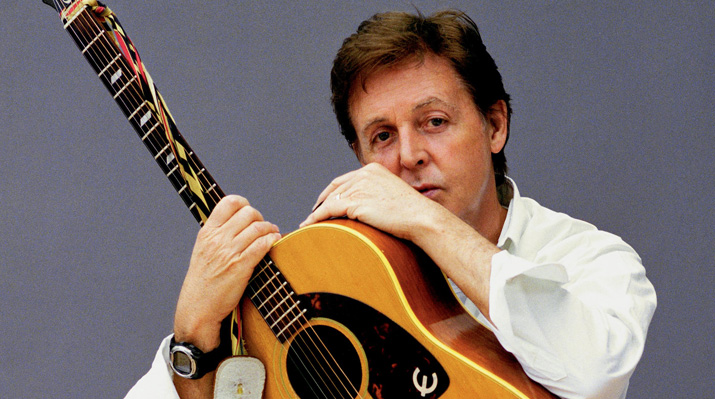
But when a remastered, or otherwise "enhanced" deluxe recording is treated with the loving care it deserves, the results can be pure magic. Last year's remastering of Band On The Run as part of Paul McCartney's ongoing "Archive Collection" was a perfect case in point.
On its three disc version, the original recording is balanced nicely by a generously selected second disc of rarities and outtakes, as well as by a bonus DVD featuring rare footage from the studio and live onstage. The remastering of the actual Band On The Run album, overseen by Beatles engineer Geoff Emerick and Macca himself, likewise hits the mark.
The two most recent entries in McCartney's "Archive Collection," are however a decidedly more mixed bag.
First, the good news.
For the remasters of his two most famous "solo" albums, McCartney and McCartney II (Sir Paul plays every single instrument on each), Macca once again oversaw the project, so at least you know the loving care department has been covered. The packages are also very nicely done, mostly recreating the original fold out sleeves of the originals in the CD booklet, along with a few extra photographs. So far, so good.
But there is simply no way around the flat sound heard on the remastered version of Macca's classic McCartney. The music on McCartney's first solo album sounds just as good today, as it did back when it was first released in the wake of the Beatles breakup. The really great songs on this album like "Maybe I'm Amazed," "Every Night," "That Would Be Something" and "Man We Was Lonely" have only improved with age. Even the seemingly knock-off instrumental pieces like "Kreen-Akore" have a certain charm to them (overlooking the fact that they seem to be there for no other real reason than to show off McCartney's chops as a one man band).
I just don't remember this album sounding anywhere near this low-fi dull when I first heard it though. Maybe this is because the "do-it-yourself," homemade nature of the original recordings don't really lend themselves to the digital transfer process — I'm really not sure. But on the remaster, the recordings are so "clean" sounding, they sound as though they have had the life sanitized right out of them.
The drums and bass tones yield a low, dull thud, and there is so little definition elsewhere I had to check my speakers to see if the left and right channels were working properly. The vocals and guitars are on top as they should be. But everything else is so evenly and flatly distributed in the mix, the recording almost sounds like it was sound proofed.
Honestly, this sounds like McCartney in mono.
The extras on the bonus disc of McCartney are likewise disappointing. Most of the material, taken from sources like the oft-seen and heard One Hand Clapping and Live In Glasgow, has been previously issued on other remastered McCartney albums. Clocking in at just 25 minutes, the running time of the second disc also comes off like a bit of a cheat. Sorry, but I gotta' call it like I hear it here.
Truth is, I really had hoped for more with this one. But I still have to label the remastered two-disc version of McCartney as a mild disappointment.
Fortunately, the remastered sound on McCartney II is a bit better than on that of its predecessor. The bad news here is the McCartney II album itself is also the far less superior of the two, taken from a purely musical perspective. The fact that the sound here is a notch above, only serves to further demonstrate the technical inadequacies of the other.
Not that McCartney II is a bad album, because it's not. It's just that outside of maybe "Coming Up," there are nowhere near as many memorable songs as on the 1970 original. If anything, Macca is to be commended for doing something this experimental at the time. From "Coming Up" on down, McCartney II also proves that Sir Paul had his ear finely tuned to the syntho-wave sounds of its eighties day.
The stuff found on the bonus disc of rarities is especially revealing in this regard. It varies wildly from the beautiful Richard Niles arranged orchestration of "Blue Sway," to the comparatively simpler holiday message of "Wonderful Christmastime" (continuing a long standing tradition of Beatles Christmas songs). Other outtakes from the period like "Check My Machine" reveal that McCartney was nearly as obsessed with electronic advances in music technology as Neil Young was at the same time with his own Trans.
The difference here is that Macca was much quieter about it. The one thing for sure here is that the outtakes and unreleased songs on the remastered McCartney II certainly reveal another side of the normally perceived to be much more musically conservative Paul McCartney. For this reason alone, the remastered McCartney II is a definite keeper.
As for the actual album?
It's a decent, if not quite perfect representation of exactly where McCartney was at when the album was originally recorded. The sound is also quite a bit better (perhaps owing to the more advanced studio technology at the time it was originally made), than on the (musically speaking anyway) much more memorable McCartney album.
At the time it was first released, McCartney II was widely regarded as an artistic comeback for the former Beatle, and this certainly shows in pop gems like the aforementioned "Coming Up" and the Kraftwerk inspired "Temporary Secretary." Likewise, Macca shows he can still deliver the token syrupy ballad with "Waterfalls."
But there are precious few songs as memorable as "Maybe I'm Amazed" here. Which is a shame because the recording on this remastered album is so much better than on 1970's far superior album McCartney.
It's still a little flat sounding, but in this case eighties synths appear to win out over the DIY technology of seventies home recording. But the main pull of McCartney II remains the extras, which simply kick the crap out of those found on the remastered McCartney.
In fairness, I haven't seen the DVD/Blu-ray footage on the even more souped up versions of these remastered albums. But the audio versions nonetheless fall a bit short.
This article was first published at Blogcritics Magazine.
Familiarity sells records.
For proof of this, look no further than the endless stream of repackaged, remastered, and in far too many cases, regurgitated deluxe reissues and boxed sets of classic albums by legacy artists — mostly from the sixties and seventies rock eras.
They just keep on coming, with no foreseeable end in sight.
When remastered deluxe sets are done right (see Neil Young's Archives Volume 1 and Bruce Springsteen's The Promise: The Darkness On The Edge Of Town Story), they can be a real treat for fans, offering up a pirates chest of previously unheard treasures like rare tracks and unseen DVD/Blu-ray concert footage.
Unfortunately, even the great ones can fall victim to a case of the record company going to the well one too many times though. The back catalogs of Elvis Costello and David Bowie for example, have by now been mined to the point of redundancy. In other cases, even the most seemingly well intentioned ideas can prove ultimately pointless.
For example, all the overdone four disc set devoted to Pet Sounds — Brian Wilson's sixties masterpiece with the Beach Boys — really succeeded in doing was proving that the original was just fine as it was, thank you very much.
But when a remastered, or otherwise "enhanced" deluxe recording is treated with the loving care it deserves, the results can be pure magic. Last year's remastering of Band On The Run as part of Paul McCartney's ongoing "Archive Collection" was a perfect case in point.
On its three disc version, the original recording is balanced nicely by a generously selected second disc of rarities and outtakes, as well as by a bonus DVD featuring rare footage from the studio and live onstage. The remastering of the actual Band On The Run album, overseen by Beatles engineer Geoff Emerick and Macca himself, likewise hits the mark.
The two most recent entries in McCartney's "Archive Collection," are however a decidedly more mixed bag.
First, the good news.
For the remasters of his two most famous "solo" albums, McCartney and McCartney II (Sir Paul plays every single instrument on each), Macca once again oversaw the project, so at least you know the loving care department has been covered. The packages are also very nicely done, mostly recreating the original fold out sleeves of the originals in the CD booklet, along with a few extra photographs. So far, so good.
But there is simply no way around the flat sound heard on the remastered version of Macca's classic McCartney. The music on McCartney's first solo album sounds just as good today, as it did back when it was first released in the wake of the Beatles breakup. The really great songs on this album like "Maybe I'm Amazed," "Every Night," "That Would Be Something" and "Man We Was Lonely" have only improved with age. Even the seemingly knock-off instrumental pieces like "Kreen-Akore" have a certain charm to them (overlooking the fact that they seem to be there for no other real reason than to show off McCartney's chops as a one man band).
I just don't remember this album sounding anywhere near this low-fi dull when I first heard it though. Maybe this is because the "do-it-yourself," homemade nature of the original recordings don't really lend themselves to the digital transfer process — I'm really not sure. But on the remaster, the recordings are so "clean" sounding, they sound as though they have had the life sanitized right out of them.
The drums and bass tones yield a low, dull thud, and there is so little definition elsewhere I had to check my speakers to see if the left and right channels were working properly. The vocals and guitars are on top as they should be. But everything else is so evenly and flatly distributed in the mix, the recording almost sounds like it was sound proofed.
Honestly, this sounds like McCartney in mono.
The extras on the bonus disc of McCartney are likewise disappointing. Most of the material, taken from sources like the oft-seen and heard One Hand Clapping and Live In Glasgow, has been previously issued on other remastered McCartney albums. Clocking in at just 25 minutes, the running time of the second disc also comes off like a bit of a cheat. Sorry, but I gotta' call it like I hear it here.
Truth is, I really had hoped for more with this one. But I still have to label the remastered two-disc version of McCartney as a mild disappointment.
Fortunately, the remastered sound on McCartney II is a bit better than on that of its predecessor. The bad news here is the McCartney II album itself is also the far less superior of the two, taken from a purely musical perspective. The fact that the sound here is a notch above, only serves to further demonstrate the technical inadequacies of the other.
Not that McCartney II is a bad album, because it's not. It's just that outside of maybe "Coming Up," there are nowhere near as many memorable songs as on the 1970 original. If anything, Macca is to be commended for doing something this experimental at the time. From "Coming Up" on down, McCartney II also proves that Sir Paul had his ear finely tuned to the syntho-wave sounds of its eighties day.
The stuff found on the bonus disc of rarities is especially revealing in this regard. It varies wildly from the beautiful Richard Niles arranged orchestration of "Blue Sway," to the comparatively simpler holiday message of "Wonderful Christmastime" (continuing a long standing tradition of Beatles Christmas songs). Other outtakes from the period like "Check My Machine" reveal that McCartney was nearly as obsessed with electronic advances in music technology as Neil Young was at the same time with his own Trans.
The difference here is that Macca was much quieter about it. The one thing for sure here is that the outtakes and unreleased songs on the remastered McCartney II certainly reveal another side of the normally perceived to be much more musically conservative Paul McCartney. For this reason alone, the remastered McCartney II is a definite keeper.
As for the actual album?
It's a decent, if not quite perfect representation of exactly where McCartney was at when the album was originally recorded. The sound is also quite a bit better (perhaps owing to the more advanced studio technology at the time it was originally made), than on the (musically speaking anyway) much more memorable McCartney album.
At the time it was first released, McCartney II was widely regarded as an artistic comeback for the former Beatle, and this certainly shows in pop gems like the aforementioned "Coming Up" and the Kraftwerk inspired "Temporary Secretary." Likewise, Macca shows he can still deliver the token syrupy ballad with "Waterfalls."
But there are precious few songs as memorable as "Maybe I'm Amazed" here. Which is a shame because the recording on this remastered album is so much better than on 1970's far superior album McCartney.
It's still a little flat sounding, but in this case eighties synths appear to win out over the DIY technology of seventies home recording. But the main pull of McCartney II remains the extras, which simply kick the crap out of those found on the remastered McCartney.
In fairness, I haven't seen the DVD/Blu-ray footage on the even more souped up versions of these remastered albums. But the audio versions nonetheless fall a bit short.
This article was first published at Blogcritics Magazine.
Wednesday, June 1, 2011
Steven Wilson, Aviv Geffen And Blackfield Hit A Home Run In Seattle
Concert Review: Blackfield At Studio 7, Seattle, WA, 5/31/11
For the Seattle stop on Blackfield's current American tour, the near capacity crowd at Studio 7, a tiny, hole in the wall club located in the city's industrial Sodo district, just a stones throw away from Qwest Field — where MLB's Seattle Mariners beat the Baltimore Orioles 3-2 on the same night — caught a break.
Following the passing of guitarist/vocalist Steven Wilson's father, several Blackfield shows were canceled as Wilson flew back home to England to pay his final respects. Thankfully for Seattle fans, their Studio 7 show marked the bands return to active duty, for what turned out to be a home run show.
Despite his recent personal loss, Wilson in particular, seemed to be particularly energized during a blazing and well balanced two hour set, drawing generously from all three of Blackfield's studio albums. When he is not busy with a multitude of other projects ranging from his more famous band Porcupine Tree to overseeing the remastering of King Crimson's back catalog, Wilson fronts Blackfield along with Israeli singer/songwriter Aviv Geffen.
For the Seattle show, Wilson even sat in briefly for the opening set from Dream Theater keyboardist Jordan Rudess. In addition to Wilson's unscheduled appearance, Rudess' treated the enraptured crowd to a virtuoso solo performance on the keys, highlighted by a brief medley of classic progressive rock tunes including Genesis' "Blood On The Rooftops."
After a brief break allowing for just about enough time to quaff a quick adult beverage, Blackfield took to the stage with a powerful version of "Blood" from their new Welcome To My DNA album. Like most of the new songs from DNA performed in Seattle, "Blood" took on a new power in a live setting only hinted at on the studio version. It was a killer opener, and a perfect segue into the song "Blackfield" from the bands debut album.
"Glass House" and "Go To Hell" also proved to be standouts from the new album, the former displaying Wilson's vocals and soaring guitar, and the latter showcasing an equally impressive vocal from Geffen. More than anything, the new songs proved just how well these two great musicians jell together as a unit.
Blackfield II — their best record for my money — was also well represented in Seattle. Although it would have been nice to hear the mysteriously absent "Christenings," great versions of "Epidemic" and "Miss U" proved to be just the right antidote.
A three song encore brought one of the best moments from Blackfield II though, as Geffen sang the lyrics to "End Of The World" from under a black hood in an apparent reference to living under the ever present shadow of terrorism in his native Israel.
It was a very powerful ending to an amazing show.
Setlist:
Blood
Blackfield
Glass House
Go To Hell
Open Mind
Pain
DNA
Waving
1000 People
Once
Hole In Me
Miss U
Zigota
Epidemic
Oxygen
Where U My Love?
Dissolving
Encore:
Hello
End Of The World
Cloudy Now
This review was first published at Blogcritics Magazine.
Concert Review: Blackfield At Studio 7, Seattle, WA, 5/31/11
For the Seattle stop on Blackfield's current American tour, the near capacity crowd at Studio 7, a tiny, hole in the wall club located in the city's industrial Sodo district, just a stones throw away from Qwest Field — where MLB's Seattle Mariners beat the Baltimore Orioles 3-2 on the same night — caught a break.
Following the passing of guitarist/vocalist Steven Wilson's father, several Blackfield shows were canceled as Wilson flew back home to England to pay his final respects. Thankfully for Seattle fans, their Studio 7 show marked the bands return to active duty, for what turned out to be a home run show.
Despite his recent personal loss, Wilson in particular, seemed to be particularly energized during a blazing and well balanced two hour set, drawing generously from all three of Blackfield's studio albums. When he is not busy with a multitude of other projects ranging from his more famous band Porcupine Tree to overseeing the remastering of King Crimson's back catalog, Wilson fronts Blackfield along with Israeli singer/songwriter Aviv Geffen.
For the Seattle show, Wilson even sat in briefly for the opening set from Dream Theater keyboardist Jordan Rudess. In addition to Wilson's unscheduled appearance, Rudess' treated the enraptured crowd to a virtuoso solo performance on the keys, highlighted by a brief medley of classic progressive rock tunes including Genesis' "Blood On The Rooftops."
After a brief break allowing for just about enough time to quaff a quick adult beverage, Blackfield took to the stage with a powerful version of "Blood" from their new Welcome To My DNA album. Like most of the new songs from DNA performed in Seattle, "Blood" took on a new power in a live setting only hinted at on the studio version. It was a killer opener, and a perfect segue into the song "Blackfield" from the bands debut album.
"Glass House" and "Go To Hell" also proved to be standouts from the new album, the former displaying Wilson's vocals and soaring guitar, and the latter showcasing an equally impressive vocal from Geffen. More than anything, the new songs proved just how well these two great musicians jell together as a unit.
Blackfield II — their best record for my money — was also well represented in Seattle. Although it would have been nice to hear the mysteriously absent "Christenings," great versions of "Epidemic" and "Miss U" proved to be just the right antidote.
A three song encore brought one of the best moments from Blackfield II though, as Geffen sang the lyrics to "End Of The World" from under a black hood in an apparent reference to living under the ever present shadow of terrorism in his native Israel.
It was a very powerful ending to an amazing show.
Setlist:
Blood
Blackfield
Glass House
Go To Hell
Open Mind
Pain
DNA
Waving
1000 People
Once
Hole In Me
Miss U
Zigota
Epidemic
Oxygen
Where U My Love?
Dissolving
Encore:
Hello
End Of The World
Cloudy Now
This review was first published at Blogcritics Magazine.
Thursday, May 26, 2011
Wednesday, May 4, 2011
All Work And No Play Makes Glen...Well You Know the Rest...
Neil Young looks out over the horizon and wonders "Where's the damn book, Glen?"
Haven't updated the blog in awhile, so I thought I'd check in and bring y'all up to speed on all things Glen.
The book: As most of you already know, I'm working furiously to meet my publishers deadline for the book I'm writing on Neil Young originally scheduled to come out this fall -- but that will more likely be published next April (at least according to my own Google searches for book store pre-orders on Neil Young FAQ).
This is mostly my own fault.
I was supposed to deliver a finished manuscript this past April, and when it became apparent I wasn't going to make that deadline, I asked for an extension until June (which my publishers at Backbeat thankfully, if reluctantly granted).
The good news, is that although things like work have gotten in the way, I'm still confident that I will make Backbeat's graciously extended deadline.
But I'm not gonna' lie here... it's gonna' be tough. I've basically got about eight chapters and 30,000 words to complete, and about four weeks to get there. I will make it, but you are still not at all discouraged to wish me luck in getting there...
Work: The new day job is both a blessing and a bitch. For those of you who endured my near continuous bitching about being unemployed for two years until last October, you already know how much I needed this. The fact that I got my underpaid gig slinging cable at all is something I am also highly grateful for. That two years of total poverty took its toll.
That said, it's been a tough ride. The schedule sucks (mid-week days off), as does the commute from West Seattle to the East Side, a monster run encompassing both the notoriously tricky West Seattle Bridge and three major freeways (I-5, I-90, and I-405). Despite the charming personality you all know and love, I also get the overall impression the youngsters at my day gig would love nothing more than to get me the fuck outta there. Hey, I gotta' call it like I see it. In just six months I've also been written up for a quick exit twice -- so far, I've managed to dodge both.
I'm probably not long for a future there, bottom line. That said, I'm doing the best I can -- and actually had a personal best sales day there today. But do I see a long term future of being screamed at by pissed off customers who don't understand their costly cable bills (and by the way, neither do I)? In a word, no I don't. I'm trying my best, I really am. But in reality the odds are not in my favor...they see me as an old fool.
I'm not of course, but in an odd sort of way, I sort of understand why they view me that way. After all, I was once an obnoxious, self-important, too cool for words twenty-something myself.
Better days lie ahead I'm sure. But for now, this is gonna' have to do. On a side note, thanks for getting Osama, Obama. Now please...please...get us some meaningful, well-paying, and yes "fun" jobs, sir.
Blogcritics: BC's role in re-establishing me as a still relevant music critic after chasing my own ass for much of the nineties following my spectacular flameout as an aspiring record exec in L.A. simply cannot be overstated, and for that I will always owe them an enormous debt of gratitude.
That said, I cannot deny the overall dip in quality of the music writing at BC over the past year in particular, nor the unfulfilled promises of improvement since the "regime change" to Technorati last year. The mass flight to greener pastures elsewhere from some of BC's best former music writers in the past 12 months or so speaks volumes -- but you already know that if you have been paying any attention.
My own recent absence at BC is largely due more to my need to get this book done than anything else -- I won't return to an active role there until NYFAQ is done (hopefully June 1). Once I do -- and if I do -- I will resume being as active as ever in my dual roles as a music editor and writer. The Rockologist and all the rest will be back in force.
But this is provided I see signs that things are improving. The fact that Donald Gibson is now the senior music ed is one of the biggest reasons I am optimistic that BC can regain its once mighty position. Donald is one of those guys who was pretty much born to edit and write about music -- and he does so very well. On the other hand, the fact that elsewhere the site has the increasing feel of a bunch of brats throwing sand at each other in a sandbox does not raise hopes that things are improving.
We'll see...
Social Life: Non existent at present, but stay tuned.
Neil Young looks out over the horizon and wonders "Where's the damn book, Glen?"
Haven't updated the blog in awhile, so I thought I'd check in and bring y'all up to speed on all things Glen.
The book: As most of you already know, I'm working furiously to meet my publishers deadline for the book I'm writing on Neil Young originally scheduled to come out this fall -- but that will more likely be published next April (at least according to my own Google searches for book store pre-orders on Neil Young FAQ).
This is mostly my own fault.
I was supposed to deliver a finished manuscript this past April, and when it became apparent I wasn't going to make that deadline, I asked for an extension until June (which my publishers at Backbeat thankfully, if reluctantly granted).
The good news, is that although things like work have gotten in the way, I'm still confident that I will make Backbeat's graciously extended deadline.
But I'm not gonna' lie here... it's gonna' be tough. I've basically got about eight chapters and 30,000 words to complete, and about four weeks to get there. I will make it, but you are still not at all discouraged to wish me luck in getting there...
Work: The new day job is both a blessing and a bitch. For those of you who endured my near continuous bitching about being unemployed for two years until last October, you already know how much I needed this. The fact that I got my underpaid gig slinging cable at all is something I am also highly grateful for. That two years of total poverty took its toll.
That said, it's been a tough ride. The schedule sucks (mid-week days off), as does the commute from West Seattle to the East Side, a monster run encompassing both the notoriously tricky West Seattle Bridge and three major freeways (I-5, I-90, and I-405). Despite the charming personality you all know and love, I also get the overall impression the youngsters at my day gig would love nothing more than to get me the fuck outta there. Hey, I gotta' call it like I see it. In just six months I've also been written up for a quick exit twice -- so far, I've managed to dodge both.
I'm probably not long for a future there, bottom line. That said, I'm doing the best I can -- and actually had a personal best sales day there today. But do I see a long term future of being screamed at by pissed off customers who don't understand their costly cable bills (and by the way, neither do I)? In a word, no I don't. I'm trying my best, I really am. But in reality the odds are not in my favor...they see me as an old fool.
I'm not of course, but in an odd sort of way, I sort of understand why they view me that way. After all, I was once an obnoxious, self-important, too cool for words twenty-something myself.
Better days lie ahead I'm sure. But for now, this is gonna' have to do. On a side note, thanks for getting Osama, Obama. Now please...please...get us some meaningful, well-paying, and yes "fun" jobs, sir.
Blogcritics: BC's role in re-establishing me as a still relevant music critic after chasing my own ass for much of the nineties following my spectacular flameout as an aspiring record exec in L.A. simply cannot be overstated, and for that I will always owe them an enormous debt of gratitude.
That said, I cannot deny the overall dip in quality of the music writing at BC over the past year in particular, nor the unfulfilled promises of improvement since the "regime change" to Technorati last year. The mass flight to greener pastures elsewhere from some of BC's best former music writers in the past 12 months or so speaks volumes -- but you already know that if you have been paying any attention.
My own recent absence at BC is largely due more to my need to get this book done than anything else -- I won't return to an active role there until NYFAQ is done (hopefully June 1). Once I do -- and if I do -- I will resume being as active as ever in my dual roles as a music editor and writer. The Rockologist and all the rest will be back in force.
But this is provided I see signs that things are improving. The fact that Donald Gibson is now the senior music ed is one of the biggest reasons I am optimistic that BC can regain its once mighty position. Donald is one of those guys who was pretty much born to edit and write about music -- and he does so very well. On the other hand, the fact that elsewhere the site has the increasing feel of a bunch of brats throwing sand at each other in a sandbox does not raise hopes that things are improving.
We'll see...
Social Life: Non existent at present, but stay tuned.
Wednesday, April 13, 2011
Steven Wilson And Aviv Geffen Reunite On Blackfield's Welcome To My DNA
Music Review: Blackfield - Welcome To My DNA
Welcome To My DNA, the third album in the on and off collaboration between Steven Wilson and Israeli singer/songwriter Aviv Geffen known as Blackfield, is a bit different from its two predecessors.
Wilson is of course, much better known to music fans in the western hemisphere as the creative mastermind behind modern progressive giants Porcupine Tree, and as the successful producer of such projects as the ongoing remastering of King Crimson's back catalog. Geffen — although far less known in this part of the world — is a huge pop star in his own right in his native Israel (where he is known as much for his outspoken political views, as he is for his music).
Coming from my own perspective as an admittedly diehard fan of Wilson's work with Porcupine Tree, Blackfield's albums have always represented a refreshing, if slightly more introspective and melancholic departure from his heavier records with PT. Aviv Geffen's role, to me at least, has always seemed to be more like a foil to Wilson, and a damned good one too — especially on songs like "Epidemic" and "Christenings" from Blackfield II.
This new album, on the other hand, is going to take some getting used to.
Geffen's presence on Welcome To My DNA is a lot more front and center for one thing. There's no more playing Andrew Ridgely to Steven Wilson's George Michael here. The music is also much lusher sounding (thanks to Wilson's densest production yet on a Blackfield album).
In fairness to Geffen (and again coming from my own somewhat admitted bias coming in as a Wilson fan), he largely rises to the challenge. Taking a much greater share of the lead vocals here (and from what I can tell, the songwriting as well), Geffen has lost most (but not all) of the distracting Israeli accent of past songs like "Epidemic." The new songs are mostly pretty strong too.
My lone complaint — and it's a relatively minor one — is that the mildly melancholic pop of previous Blackfield albums gives way to outright pessimism here, especially on darker songs like "Go To Hell" and the apocalyptic "Oxygen." The latter takes place in a world where "there's no oxygen left on our planet" and "everyone's sleeping with guns, someone's going to die."
Hey, I'm all for going green too. But can you say downer, dude?
But in the midst of all the gloom and doom, there are still some glistening modern alternative pop tracks to be found between the cracks. The first single from the album, "Waving" is a particularly good example. Steven Wilson is back up front on vocals and guitar for one thing. And despite the presence of some occasionally distracting strings, Wilson's ear for a pop hook remains as strong as ever (I'm assuming Wilson wrote this one).
Wilson's influence also comes through on tracks like "Blood" (the albums heaviest track, it plays almost like an outtake from PT's The Incident). The opening track, "Glass House," is another standout with a Steven Wilson lead vocal, and a string arrangement that manages the trick of being both subtle and lush at the same time.
Welcome To My DNA is Blackfield's most pronounced walk through the minefield of darkness and light yet. I suspect it will be growing on me for quite awhile.
This article was first published at Blogcritics Magazine.
Music Review: Blackfield - Welcome To My DNA
Welcome To My DNA, the third album in the on and off collaboration between Steven Wilson and Israeli singer/songwriter Aviv Geffen known as Blackfield, is a bit different from its two predecessors.
Wilson is of course, much better known to music fans in the western hemisphere as the creative mastermind behind modern progressive giants Porcupine Tree, and as the successful producer of such projects as the ongoing remastering of King Crimson's back catalog. Geffen — although far less known in this part of the world — is a huge pop star in his own right in his native Israel (where he is known as much for his outspoken political views, as he is for his music).
Coming from my own perspective as an admittedly diehard fan of Wilson's work with Porcupine Tree, Blackfield's albums have always represented a refreshing, if slightly more introspective and melancholic departure from his heavier records with PT. Aviv Geffen's role, to me at least, has always seemed to be more like a foil to Wilson, and a damned good one too — especially on songs like "Epidemic" and "Christenings" from Blackfield II.
This new album, on the other hand, is going to take some getting used to.
Geffen's presence on Welcome To My DNA is a lot more front and center for one thing. There's no more playing Andrew Ridgely to Steven Wilson's George Michael here. The music is also much lusher sounding (thanks to Wilson's densest production yet on a Blackfield album).
In fairness to Geffen (and again coming from my own somewhat admitted bias coming in as a Wilson fan), he largely rises to the challenge. Taking a much greater share of the lead vocals here (and from what I can tell, the songwriting as well), Geffen has lost most (but not all) of the distracting Israeli accent of past songs like "Epidemic." The new songs are mostly pretty strong too.
My lone complaint — and it's a relatively minor one — is that the mildly melancholic pop of previous Blackfield albums gives way to outright pessimism here, especially on darker songs like "Go To Hell" and the apocalyptic "Oxygen." The latter takes place in a world where "there's no oxygen left on our planet" and "everyone's sleeping with guns, someone's going to die."
Hey, I'm all for going green too. But can you say downer, dude?
But in the midst of all the gloom and doom, there are still some glistening modern alternative pop tracks to be found between the cracks. The first single from the album, "Waving" is a particularly good example. Steven Wilson is back up front on vocals and guitar for one thing. And despite the presence of some occasionally distracting strings, Wilson's ear for a pop hook remains as strong as ever (I'm assuming Wilson wrote this one).
Wilson's influence also comes through on tracks like "Blood" (the albums heaviest track, it plays almost like an outtake from PT's The Incident). The opening track, "Glass House," is another standout with a Steven Wilson lead vocal, and a string arrangement that manages the trick of being both subtle and lush at the same time.
Welcome To My DNA is Blackfield's most pronounced walk through the minefield of darkness and light yet. I suspect it will be growing on me for quite awhile.
This article was first published at Blogcritics Magazine.
Sunday, April 3, 2011
On Leon Russell And Elton John
So I have to honest here. The first time I ever heard of Leon Russell was as a pre-teen kid cruising my way through the pages of Circus Magazine, where I came across an an ad for Leon's debut solo album, which was at the time still called Can A Blue Man Sing The Whites?.
Cool title, I thought.
The album was of course eventually released as Leon Russell's self-titled solo album by Shelter Records (not sure whatever happened to that original title), and upon the first time I heard it, I was instantly enthralled.
But to be completely honest here, the first side of this album did absolutely nothing for me at the time. It was the second side that I really liked.
I liked Leon's weathered, sand-papery voice well enough, and the production of the record, populated as it was by the then very much in vogue Muscle Shoals sound of people like Delaney and Bonnie Bramlett, by way of British pop stars like Eric Clapton also went down very easy.
But to me, a few of the songs were still kind of lacking.
The second side however? Well, that was something else entirely.
Kicking off with "Delta Lady," and proceeding from there to scream through an entire side of New Orleans delta funk like "Pisces Apple Lady" and "Roll Away The Stone," this damn thing didn't let up for a second. I was instantly hooked. Anchoring it all was Leon's world weary rasp, set against some of the funkiest, Nawlins' honky tonk piano you will ever hear in this lifetime.
From this auspicious debut as an amazing solo artist who was clearly (at least to my pre-teen ears) one to be reckoned with, Leon went down hill fast, at least for my money he did. Latter albums yielding hits like "Tightrope," as well as ill-advised experiments like the country tinged "Hank Wilson Is Back" albums, just never completely recaptured the spark of that initial, brilliant debut album for me.
Of course, let's keep things in perspective here. I was, after all, still a kid.
Obviously, Leon also went on to much bigger and better things. His stint as the bandleader and "master of space and time" in Joe Cocker's extended Mad Dogs and Englishmen band is particularly memorable — and was obviously pivotal in establishing him as one of the true greats.
Still, as great as Joe Cocker's blues shouting on his version of "Delta Lady" is on the Mad Dogs double live album from 1970 (and it is pretty great), I'll take Leon's, less celebrated original version in a heartbeat.
Not long after, Leon stole the show at the all-star benefit Concert For Bangla Desh show, by kicking the living crap out of a blues medley including songs like "Youngblood" and "Jumping Jack Flash." The other headliners that night, which included no less than George Harrison, Bob Dylan and Eric Clapton didn't stand a chance against him.
Which brings me to last nights episode of Saturday Night Live...
Like Leon Russell himself, Elton John is a great artist, who I personally feel shot his creative wad fairly early in the game, but for entirely different reasons.
In my own opinion, Elton's first five or so several records represent his best work. But even these are spotty. For every truly brilliant moment like "Burn Down The Mission," "Rocket Man," and "Madman Across The Water, there are also ample amounts of filler on these records.
And once we get past Goodbye Yellow Brick Road, the filler eventually gives way to paint by numbers hit-making. By the time of the eighties, even that formidable, but equally formulaic well of catchy pop tunes began to run dry.
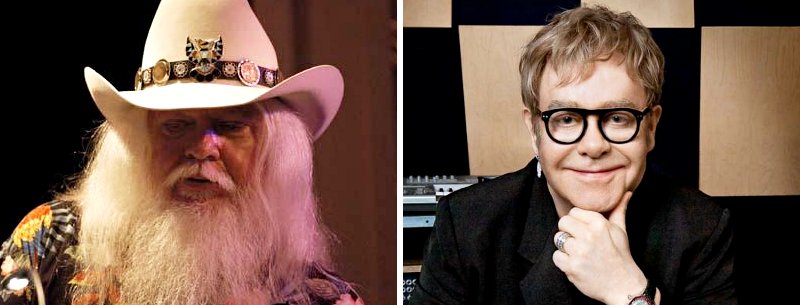
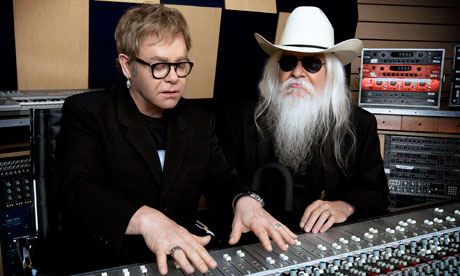
The thing is, even for all of his concessions to blatant, and occasionally schmaltzy commercialization over the years, Elton's heart still seems to be in the right place — and nowhere is this more apparent than in the way he has taken Leon Russell under his wing in the past year.
I'm not entirely sure what got Leon to the place where Elton found him — apparently broke and semi-destitute, in failing health, and with his status as a legendary artist largely forgotten by a brutally short-sighted music industry.
All I know, is Elton came to his rescue in the past year — both making an album and going on tour with him and inducting him into the Rock And Roll Hall of Fame — and Leon has acknowledged the debt in kind.
Elton John's heart has never been in question in that respect. Still, it was kind of sad to see Elton and Leon together on Saturday Night Live this past weekend, when the former hosted the show. I give Elton ultimate credit for bringing Leon along to what ultimately may prove to be his last dance before a nationally televised audience.
But seeing Leon as a shell of his former "master of space and time" self (his voice was barely audible in the sound mix) was also kind of sad — especially as Elton participated in skit after self aggrandizing skit hammering home the fact that he is a very famous, very wealthy, and very gay pop star.
Look, Elton, we get it. You're rich. You're famous. You're gay. We get it.
But thank you once again for reaching out to Leon Russell.
This article was first published at Blogcritics Magazine
So I have to honest here. The first time I ever heard of Leon Russell was as a pre-teen kid cruising my way through the pages of Circus Magazine, where I came across an an ad for Leon's debut solo album, which was at the time still called Can A Blue Man Sing The Whites?.
Cool title, I thought.
The album was of course eventually released as Leon Russell's self-titled solo album by Shelter Records (not sure whatever happened to that original title), and upon the first time I heard it, I was instantly enthralled.
But to be completely honest here, the first side of this album did absolutely nothing for me at the time. It was the second side that I really liked.
I liked Leon's weathered, sand-papery voice well enough, and the production of the record, populated as it was by the then very much in vogue Muscle Shoals sound of people like Delaney and Bonnie Bramlett, by way of British pop stars like Eric Clapton also went down very easy.
But to me, a few of the songs were still kind of lacking.
The second side however? Well, that was something else entirely.
Kicking off with "Delta Lady," and proceeding from there to scream through an entire side of New Orleans delta funk like "Pisces Apple Lady" and "Roll Away The Stone," this damn thing didn't let up for a second. I was instantly hooked. Anchoring it all was Leon's world weary rasp, set against some of the funkiest, Nawlins' honky tonk piano you will ever hear in this lifetime.
From this auspicious debut as an amazing solo artist who was clearly (at least to my pre-teen ears) one to be reckoned with, Leon went down hill fast, at least for my money he did. Latter albums yielding hits like "Tightrope," as well as ill-advised experiments like the country tinged "Hank Wilson Is Back" albums, just never completely recaptured the spark of that initial, brilliant debut album for me.
Of course, let's keep things in perspective here. I was, after all, still a kid.
Obviously, Leon also went on to much bigger and better things. His stint as the bandleader and "master of space and time" in Joe Cocker's extended Mad Dogs and Englishmen band is particularly memorable — and was obviously pivotal in establishing him as one of the true greats.
Still, as great as Joe Cocker's blues shouting on his version of "Delta Lady" is on the Mad Dogs double live album from 1970 (and it is pretty great), I'll take Leon's, less celebrated original version in a heartbeat.
Not long after, Leon stole the show at the all-star benefit Concert For Bangla Desh show, by kicking the living crap out of a blues medley including songs like "Youngblood" and "Jumping Jack Flash." The other headliners that night, which included no less than George Harrison, Bob Dylan and Eric Clapton didn't stand a chance against him.
Which brings me to last nights episode of Saturday Night Live...
Like Leon Russell himself, Elton John is a great artist, who I personally feel shot his creative wad fairly early in the game, but for entirely different reasons.
In my own opinion, Elton's first five or so several records represent his best work. But even these are spotty. For every truly brilliant moment like "Burn Down The Mission," "Rocket Man," and "Madman Across The Water, there are also ample amounts of filler on these records.
And once we get past Goodbye Yellow Brick Road, the filler eventually gives way to paint by numbers hit-making. By the time of the eighties, even that formidable, but equally formulaic well of catchy pop tunes began to run dry.
The thing is, even for all of his concessions to blatant, and occasionally schmaltzy commercialization over the years, Elton's heart still seems to be in the right place — and nowhere is this more apparent than in the way he has taken Leon Russell under his wing in the past year.
I'm not entirely sure what got Leon to the place where Elton found him — apparently broke and semi-destitute, in failing health, and with his status as a legendary artist largely forgotten by a brutally short-sighted music industry.
All I know, is Elton came to his rescue in the past year — both making an album and going on tour with him and inducting him into the Rock And Roll Hall of Fame — and Leon has acknowledged the debt in kind.
Elton John's heart has never been in question in that respect. Still, it was kind of sad to see Elton and Leon together on Saturday Night Live this past weekend, when the former hosted the show. I give Elton ultimate credit for bringing Leon along to what ultimately may prove to be his last dance before a nationally televised audience.
But seeing Leon as a shell of his former "master of space and time" self (his voice was barely audible in the sound mix) was also kind of sad — especially as Elton participated in skit after self aggrandizing skit hammering home the fact that he is a very famous, very wealthy, and very gay pop star.
Look, Elton, we get it. You're rich. You're famous. You're gay. We get it.
But thank you once again for reaching out to Leon Russell.
This article was first published at Blogcritics Magazine
Subscribe to:
Posts (Atom)