Thursday, September 1, 2011

The Joyous Rock And Holy Roller Noise Of Kings Of Leon


Sometimes it takes something like watching a movie to really "get" an artist or band. This week, after watching multiple screenings of Stephen C. Mitchell's Talahina Sky: The Story of Kings Of Leon documentary on Showtime, I think I may have finally gotten the appeal of the post-modern, southern fried, gospel tinged rock of the Followill boys.

Better late than never I reckon. The thing is, it's still not for the reasons you might expect.

As a live band — despite their recent graduation to headlining arenas and stadiums — Kings Of Leon have yet to take that next big step which elevates them to the big leagues as a "must see" attraction on the same level as a Bruce Springsteen, U2, Radiohead or even Coldplay.

In fairness though — and based on the all-too-brief concert clips in this film — Kings Of Leon still rock convincingly enough. But outside of the big lights and production values that come when your albums begin to do the platinum business KoL's have, there is little difference between their current use of stagecraft, and the not-quite-ready-for-prime-time band I saw open up for Bob Dylan nearly a decade ago.

With a few notable exceptions (like the gorgeous "Talahina Sky," which closes this film on a perfectly bittersweet note of uncertainty that I'm sure was completely intentional), Kings Of Leon's songs also still fall in the mostly very good to just above average range.

What does come through about Kings Of Leon in Talahina Sky though, is the fact that this is an extremely earnest and thoughtful, sincere and likable bunch (especially Caleb). This is a band who rose from very poor and humble beginnings to their current (if somewhat tenuous) status as perhaps the last truly great American rock and roll band.


Fan or not, Talahina Sky: The Story of Kings Of Leon is not only a film that will leave you rooting for this band to carry on — but one which will stick with you for days on end after seeing it.

The Kings Of Leon story is already well known to those who follow such things. The Followill brothers (Caleb, Jared, and Nathan), along with cousin Matthew, are the rock and roll spawn of a southern Bible Belt family led by tent revival preacher Ivan Followill. With no apologies, KoL left that Red State, Pentecostal existence behind to conquer the music world as international rock stars. Except, at least according to this uncommonly honest and unguarded rock-doc, maybe they didn't leave it back in the church at all. Not completely, anyway.


The story of rock and roll artists coming from church backgrounds, and then going on to a life long struggle between the pleasures of the flesh and the joys of the spirit is of course nothing new — especially in the deep south. Artists ranging from Elvis and Johnny Cash, to Jerry Lee Lewis and Little Richard have famously fought this spiritual battle between a higher calling and the so-called "devil's music" throughout their careers, and often in quite public fashion. In the case of Kings Of Leon front man Caleb Followill, he even aspired to follow his father's footsteps into the pulpit from an early age.

In Mitchell's Talahina Sky: The Story of Kings Of Leon, we see the way this inner struggle between flesh and spirit can exact a profound psychological toll, in up close and personal fashion.


This is possibly the closest thing to a "real time" story of this type ever made, and although the notoriously hard drinking Kings Of Leon aren't a band particularly known for their musical proselytizing, this film shows they haven't left their faith completely behind either. In Caleb's case, this inner turmoil seems to manifest itself most dramatically when he drinks — which he does often here.

In light of recent events which have cast some question over the future of Kings Of Leon as a band, Mitchell's film is also much more than just the latest exercise in self-aggrandizing rock-doc puffery. Taken in this context, it is actually quite the eye-opener.

Much of the film is framed against the backdrop of the annual Followill family reunion picnic, which takes place somewhere on a private patch of creekside land tucked deep inside the furthest boonies of Oklahoma. Here we see the Followill boys engaged in wholesome family activities like group prayer, pitching horseshoes, fishing for crawdads, and drinking plenty of hooch.

This is a tight knit clan of cousins, uncles, grandmas and grandpas that are also clearly quite proud of their most celebrated sons, the Followill boys of Kings Of Leon. Even so, fame is still defined by some of these folk as meaning being referenced on the game show The Price Is Right.


With a colorful cast of friends and relatives that seems to have sprung straight out of some backwoods trailer park, the Okie-authenticity of these characters is hard to miss. Good old boys like Uncle Cleo (who died of cancer shortly after this film was completed) and roadie cousin Christopher "Nacho" Followill make nighttime shots gathered around a raging campfire eerily reminiscent of a white supremacists gathering (minus the racist elements, of course).

Numerous home movies taken from the Followill boys childhood provide the clearest look at the real backstory here though. At times, these private family reels seem to be pieced together without much regard for continuity, giving the film the occasional feel of patchwork. But taken together, they tell what may be the most crucial element of the overall Kings Of Leon story.

We see Caleb and Nathan as squeaky clean church boys singing hymns for the congregation, scant years prior to their transformation into boozing, worldly rock stars. But we also learn that when their father went from preaching the gospel at revival meetings to hitting the bottle at local beer joints, it took a heavy emotional toll on the Followill boys, and on their faith.


At this point, any sheltered illusions the Followills had of a two dimensional world consisting only of saints and sinners were pretty much shattered. Caleb — remember, this is the sibling who once aspired to become a preacher himself — in particular seems to continue struggling with these lingering demons.

In one of Talahina Sky's more telling moments, we hear Caleb say "As soon as I got a record deal...I knew I was going to hell." There are also numerous scenes cut throughout the film of what appears to be a recent one-on-one interview between Caleb and the unseen camera man. Here, Caleb drunkenly rambles on about the band, his life and his mortality, as he proceeds to smoke and drink literally everything in sight.

We also see Caleb fighting with his bandmates in the studio, at one point mercilessly berating cousin Matthew over a guitar part, and finally being read the riot act by brother Nathan. In the very next scene, we see the band come back together in a circle of prayer, with all transgressions apparently forgiven (for the moment, anyway).


With the recent cancellation of an American tour following Caleb's strange outburst during a concert in Texas putting a question mark on the band's future, Talahina Sky places these events into a much larger context. Their current hiatus has been officially explained away as a much needed break and an opportunity for Caleb to heal up his vocal chords.

But Twitter posts from the band members themselves have done little to quiet the Caleb rehab rumors out there. What is clear in watching this film, is that this is a band who are collectively dealing with considerable issues, and that Caleb himself seems to be wrestling with a personal crisis of conscience and faith.

But what is also clear is that these are four very likable, mostly good, clean Christian boys, with four very distinct personalities. Jared is the most "rock star" of the group, Nathan is the one who is "all business, all the time," and Matthew, as seen here anyway, seems to be the adorable goofball. Caleb, of course, is the earnest thinker who carries the weight of the world on his shoulders, which may at least partially explain his searching for the answers inside of a bottle.


Fans of this band will find that Stephen C. Mitchell's Talahina Sky: The Story of Kings Of Leon provides at least some of these answers (not to mention some pretty great music). It is also the sort of rare, unvarnished insider look into the private lives of jet-setting rock stars — complete with warts and all — that makes you wonder what possessed the band members to sign off as executive producers for this project. Ultimately though, this is a film that makes a great argument that some rock stars are just as human as the rest of us — at least if they happen to be the Kings Of Leon anyway.

I'll be rooting for them. Talahina Sky: The Story of Kings Of Leon is currently playing on cable television's Showtime network. You'll find playing times by checking for them at Sho.com.

This article was first published at Blogcritics Magazine.

Thursday, August 25, 2011

Patti Smith's Outside Society: A Greatest Hits Set From An Artist Who Didn't Have Any

Music Review: Patti Smith - Outside Society


If you are looking for the definitive overview of Patti Smith's legendary career, the just released Legacy Recordings compilation Outside Society is not it. The closest thing out there to that sort of comprehensive retrospective of Smith's groundbreaking work, complete with prerequisite rare tracks and alternate takes, remains the Land (1975 - 2002) compilation — and that set focuses mainly on her years with Arista Records.

However, as a brief introduction to Patti Smith, Outside Society works well enough as a sampler. You might even call this album a kind of greatest hits set from an artist who really didn't have any (save for "Because The Night," the collaboration with Bruce Springsteen that remains her most famous song).

Outside Society (which takes its name from a lyric to her song "Rock And Roll Nigger") is mostly notable because it draws equally from all phases of Patti Smith's 35 years as a recording artist. It brings material from both the Arista and Columbia Records eras together for the very first time on a single disc.

The only real complaint here, is that by following the sort of "greatest hits" mentality that apparently went into the making of this collection (despite the active participation of Patti Smith herself), Outside Society really only skims the surface. The way that longer, more expressive pieces like "Birdland" and "Land" (from Patti Smith's brilliant 1975 debut album Horses), are glossed over in favor of shorter, more radio ready songs is likely to be a disappointment to long time fans.

It is tone poems like these that helped make Patti Smith's reputation as punk rock's original reigning queen of spoken word, stream of consciousness poetry in the seventies. Here, they are overlooked to focus on more traditionally structured rock songs like "Because The Night" and "Summer Cannibals," as well as her cover versions of songs like Kurt Cobain's "Smells Like Teen Spirit" and Roger McGuinn's "So You Want To Be A Rock And Star." In that respect, Outside Society really only presents one side of this multifaceted artist.

Even so, there is still a lot to like here. Outside Society covers all the bases in terms of being a well rounded collection of the hits. From "Gloria" and "Because The Night" to "Dancing Barefoot" and "People Have The Power," the song selection does a great job of gathering her career highlights together on a single disc.


Patti Smith's poetic talents do not go completely unnoticed here either. The inclusion of songs like "Pissing In A River," "Free Money" and "Aint' It Strange" accomplishes that trick nicely (if too briefly), as does her blazing performance of "Rock And Roll Nigger" (which is thankfully unedited here). Patti Smith's gift for interpretation is best showcased here with her version of Cobain's "Teen Spirit," which is broken down into a minimalist dirge that is simply spellbinding.


Longtime fans will also appreciate the inclusion of liner notes written by Patti Smith herself, where she offers her own impressions on each of the eighteen songs in this collection. As a career defining anthology, Outside Society is anything but complete. For that, fans would be far better served with Land, or by just picking up a copy of Horses (still her best). But for first timers in search of a quick test drive, you could do a lot worse than this.

This article was first published at Blogcritics Magazine.

Friday, August 19, 2011

Muddy Waters: Aggro Rockers Puddle Of Mudd Paddle Into The Seventies

Music Review: Puddle Of Mudd - Re:(disc)overed


Under normal circumstances, Puddle Of Mudd's brand of aggro-metal isn't the sort of thing that really floats my boat. Crap, I don't even really like these guys. But this album isn't exactly your typically tattooed trip to the mosh-pit either.

On Re:(disc)overed, this mid-western band of hard rock numbskulls venture into the muddy waters of the seventies, covering classic tunes by everyone from bands you'd expect like AC/DC and Led Zeppelin, to the more unlikely choices of Elton John and Neil Young. With vintage tracks from the likes of Free and the James Gang rounding things out, the playlist here comes straight from a seventies FM rock radio programmer's log, and serves as an instant reminder of why that format is so sorely missed today. It certainly beats the hell out of the Black Eyed Peas, Britney and Bieber.

The question here is, do the Mudd boys pull it off? Surprisingly, the answer is mostly yes.

In keeping with the seventies spirit, the cover art of the CD is a celebration of the vinyl album format. The front sleeve features an old record player cut from the original RCA Records "Nipper" days, and the CD itself is designed to look like a vinyl LP. When you open up the seventies style foldout cardboard sleeve, it even smells kind of like an album.

Mudd's take on the Stones' "Gimme Shelter" maintains this vibe of authenticity, right down to soulful backing vocals that do a nice job of duplicating Merry Clayton's from the original version. The band also adds just the right touch of nineties hard rock energy here, without ever overdoing it to excess. So far, so good.

Likewise, a nice version of Neil Young's "Old Man" remains very true to the original, even going so far as to duplicate the pedal steel and banjo. The one minor quibble here is the chorus of background vocals, which sound just a bit overproduced.


The thing that gives each of these tracks a fresh sounding quality though is Wes Scantlin's vocals, which display a bit of the drawl normally associated with southern rockers like Lynyrd Skynyrd. Come to think of it, these guys probably would've done a bang-up job covering somebody like Skynyrd. Maybe, next time.

This approach also works well on a version of "Stop Draggin' My Heart Around," where Scantlin pretty much nails the Tom Petty part and guest vocalist BC Jean turns in a likewise near perfect Stevie Nicks. Scantlin also does a very pretty sounding, if just ever so slightly overdone "Rocket Man" by Elton John.

By the time of Steve Miller Band's "The Joker" however, things start to wear a little thin. There is a growing feeling that in their obvious affection for these songs, they are also playing it a little too safe. At this point, you really start to wonder if Puddle Of Mudd is going to bring something a little more original to the mix.


Fortunately, the Mudd-Pudds are much more in their element when they crank up the amps to take on seventies hard rock chestnuts like AC/DC's "TNT," Billy Squier's "Everybody Wants You," and Free's "All Right Now." The band sounds right at home here, having fun and rocking out like a band of stoner kids headlining their very first high school kegger.

Despite a tendency towards safe arrangements and occasional overproduction (particularly with the backing vocals), Puddle Of Mudd's Re:(disc)overed is ultimately saved by the fact that it was clearly a labor of love for them to make.

This is the sound of a bunch of grown men channeling the sounds of their misspent classic rock youth, and obviously having a blast. Which translates into a very fun, if slightly guilty sounding pleasure for the rest of us.

This article was first published at Blogcritics Magazine.

Thursday, August 11, 2011

Alice Cooper's New Nightmare: The Original Billion Dollar Babies And...Ke$ha?


Forget about Led Zeppelin and Pink Floyd. The real reunion that fans of 70s classic rock least expected to ever see happen was the high heeled boys of the original Alice Cooper band getting back together. Well don't look now, but in just a few weeks, on September 13, hell — no, not the fake Eagles version, but the actual, real hell — is about to freeze over.

On that day, Universal Music Group will release Alice Cooper's long awaited sequel to his classic 1975 album Welcome To My Nightmare. More than thirty years in the making, Welcome 2 My Nightmare caps off an amazing year in Alice Cooper's already legendary career.

In a year which has already seen Alice receive his long overdue induction into the Rock & Roll Hall Of Fame, Welcome 2 My Nightmare reunites Alice with the surviving members of his original, greatest band for the first time since 1973's Muscle Of Love.

To put this in its proper perspective, the original 1975 album Welcome To My Nightmare was Alice Cooper's first album without the guys responsible for his brief, but meteoric ride — roughly 1972-1974 — from freak sideshow cult status, to arguably the biggest selling album artist and concert attraction in the entire world.
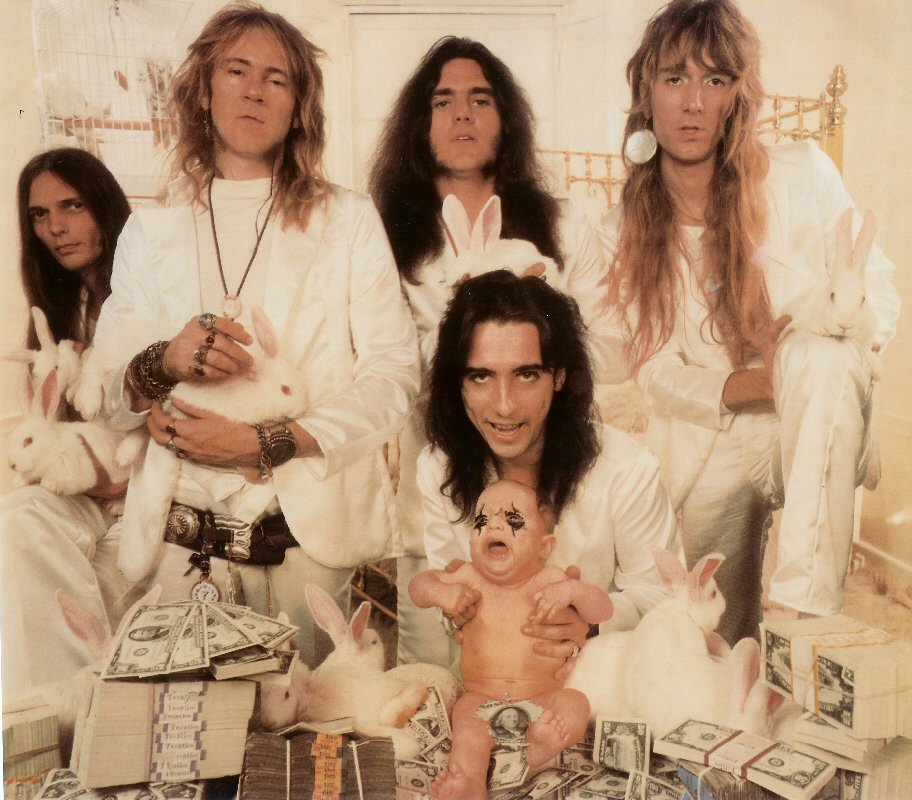
In those two short years, the albums Love It To Death, Killer, School's Out, and especially 1973's Billion Dollar Babies firmly established the original Alice Cooper band as not only the biggest — but also the most dangerous — rock and roll band on Earth.

In the process, the band's gender bending persona and elaborate, often blood dripping stage shows — where Alice was routinely executed onstage every night by simulated hanging or guillotine — established the template for Kiss, Marilyn Manson, Slipknot, White Zombie, and virtually every other theatrical shock rock act which has come ever since. Not a one of which has yet to top the original.

The fact that Alice Cooper's reunion with this band comes on the sequel to the album that marked their breakup is somewhat ironic. While Welcome To My Nightmare was both a commercial success at the time and a landmark in its own right, most fans agree it also marked the beginning of an artistic decline that was further accelerated by Alice's own personal, and long since well documented demons.


Welcome 2 My Nightmare reunites Alice Cooper with his original Billion Dollar Babies, including bassist Dennis Dunaway; drummer Neal Smith; and guitarist Micheal Bruce (who also co-wrote some of Alice's biggest hits like "I'm Eighteen") on three tracks, including "When Hell Comes Home." Unfortunately, the late guitarist Glenn Buxton is the lone member of the band who didn't live to see this historic reunion. The album is also produced by Bob Ezrin, the man behind the controls for all of Alice Cooper's original 70s classics.

The album also includes contributions from guitar great Steve Hunter (best known for his work on the original Nightmare album, as well as on Lou Reed's classic live Rock And Roll Animal album), and a somewhat unlikely appearance by teen pop sensation Ke$ha on the perhaps appropriately titled "Disco Bloodbath Boogie Fever."


Of Ke$ha's contribution, Alice says "I think a lot of my audience is going to go 'KE$HA!?', but she probably wrote the most wicked lyrics in the song – we had to rein her in. I like people to know that just because artists are put in a pigeon hole, that doesn't mean that's what they are. Give people a little room.”

Ke$ha or not, we like what we have heard thus far. From the doomy rock of "When Hell Comes Home," to the surprisingly pretty "Something To Remember Me By" (Alice's emotional range as a vocalist has long been his best kept secret), Welcome 2 My Nightmare sounds a whole lot like the classic Alice Cooper album fans have waited decades for to us. Look for a more full review here on these pages soon.

Alice Cooper's Welcome 2 My Nightmare arrives in stores and digitally on September 13.

Welcome 2 My Nightmare Track Listing:

1. I Am Made Of You
2. Caffeine
3. The Nightmare Returns
4. A Runaway Train
5. Last Man On Earth
6. The Congregation
7. I'll Bite Your Face Off
8. Disco Bloodbath Boogie Fever
9. Ghouls Gone Wild
10. Something To Remember Me By
11. When Hell Comes Home
12. What Baby Wants
13. I Gotta Get Outta Here
14. The Underture

This article was first published at Blogcritics Magazine.

Friday, July 29, 2011

Phil Ochs: Artist, Activist and American

Music DVD Review: Phil Ochs: There But For The Fortune


Kenneth Bowser's Phil Ochs: There But For The Fortune is a fascinating documentary overview of the largely unheralded, overlooked sixties protest singer who spent the bulk of his career in the shadow of his more famous, critically acclaimed friend and inspiration Bob Dylan. However, as this film so often poignantly illustrates, where Dylan chose to shroud his persona in a cloud of vagueness and mystery, Ochs wore his political values much more visibly on his sleeve.

While Dylan's protest songs may have led the political charge of the sixties progressive "movement," they were just as often measured by the sort of lyrical ambiguity that was such an essential element of the mystique he was creating even back then.

By contrast, Phil Ochs took a far more direct approach in songs like "There But For The Fortune" (a song most often identified with fellow protest icon Joan Baez), the antiwar anthem "I Aint' Marching Anymore," and "Love Me, I'm A Liberal," a biting satirical commentary directed more cynically towards his own. Songs like these and others left little room for doubt of Phil Ochs' lefty politics.

Arriving on the burgeoning New York folk scene at roughly the same time as Dylan, Ochs quickly befriended the future "voice of a generation" and adjusted his own ambitions accordingly — deciding he would need to settle on being merely "the second best songwriter in the world."

But as Dylan set out to conquer the music world, Ochs set his own sights on the larger goal of actually changing it, organizing benefit concerts for the causes of union workers and civil rights. Eventually he would take the equivalent of a self inflicted bullet for these beliefs.

Although Ochs artistic and commercial fortunes would take many twists and turns over the years, he never strayed far from his original political idealism. As this film so vividly points out (backing it up with rare, original footage from the period), even as Ochs was enjoying a minor commercial radio hit with "Outside Of A Small Circle Of Friends" (from the A&M records album Pleasures Of The Harbor), he was organizing the Yippie Party with fellow radicals Abbie Hoffman, Jerry Rubin and Paul Krassner. When the Yippies famously disrupted the 1968 Democratic National Convention in Chicago, Phil Ochs was right there in the middle of the tear gas and the pepper spray.

But the cracks in Ochs' fragile, idealistic hopes for progressive change were beginning to show even then. By the time of the political assassinations of Robert Kennedy, Martin Luther King Jr., and especially his friend Chilean protest singer Victor Jana (murdered by soldiers in a football stadium in the coup which toppled the government of President Allende), they had grown into an insurmountable chasm. This was followed in short order by alcoholism, mental illness and Ochs' eventual suicide in 1975.

All of this — accompanied by footage that is quite riveting, yet often painful to watch — is documented in Kenneth Bowser's Phil Ochs: There But For The Fortune.


Made with the blessing and participation of family members like brother and former manager Micheal Ochs, the film combines rare concert and newsreel footage and new interviews with Joan Baez, Tom Hayden, Pete Seeger, Sean Penn, Peter Yarrow, Billy Bragg and other contemporaries. The result is a fascinating, sympathetic and long overdue career study of this criminally overlooked artist, activist and American.

The DVD extras — which include a photo gallery and a director's bio — aren't all that great. But the rare concert and historical archive footage makes this a film that is more than worth your attention.

This article also appears at Blogcritics Magazine.

Sunday, July 24, 2011

Making Sense of Amy Winehouse And The 27s Tragedy


The death of Amy Winehouse is a tragedy. But what might be the saddest commentary of all has been all of the Monday morning speculation — both in the media and elsewhere — surrounding it.

For the love of God people, it isn't even Monday yet.

Over the course of the next several days and weeks, you are going to hear a lot more of it too — particularly once the medical examiner's report comes in (which could be as early as Monday, according to some published reports). The fact is, even before family, friends and fans have been given the chance to take a proper step back to absorb and reflect, it has already begun.

The glib and dismissive "I told you so" tone of some of the comments that have popped up on internet discussion boards over the past 48 hours, has been particularly distasteful. Never mind the fact that perhaps we've all been guilty of such armchair commentary on occasion. When Alice In Chains vocalist Layne Staley overdosed back in 2002, I joined many others in Seattle's music community in shaking my head, perhaps a little too condescendingly, and with a knowing sigh.

Crass as this type of behavior might be though, it is also sadly predictable. Some might even argue it as a way of coping with grief, albeit a strange and perhaps tactless one. Nonetheless, it's both amazing and unfortunate how celebrity death has the side-effect of transforming so many of us into instant experts on subjects as complex as addiction and mental illness. Not to mention turning still more of us into foolish, obnoxiously prognosticating Nostra-dumbasses.

Among the strangest reports out there though, have been the odd articles popping up everywhere linking Amy Winehouse's death to something called the "27 Club."


Many of the internet posts on this subject have a certain Twilight Zone quality to them — connecting the dots between the sex and drugs and rock and roll lifestyle and things like astrology, numerology, and other assorted New Age mumbo-jumbo. I even saw a post that attempted to draw a straight line between Amy Winehouse and Jesus Christ himself (was Jesus crucified at 27? Uh, no...he was 33).

Others, however, are of a more blatantly exploitative nature. The authors of the book The 27s: The Greatest Myth Of Rock And Roll for example, have wasted no time claiming credit for predicting Winehouse's membership in "The Club." Wow, nice "hit" there guys.

According to the same book, the official number of rock stars to die at 27 is 34 (and now 35, with the addition of Amy Winehouse to the list). On the surface at least, this high number — beginning in 1938 with the mysterious poisoning death of legendary bluesman Robert Johnson, and continuing with iconic names like Brian Jones, Jimi Hendrix, Jim Morrison, Janis Joplin, Kurt Cobain and other lesser known names like Uriah Heep bassist Gary Thain — is striking, especially when the relationship with substance abuse is figured into the mix.


It is this connection that carries along with it the mythical sort of connotations you'd expect. In the minds of some, premature death, tragic as it is, plays perfectly into the whole "live fast, die young, and leave a good corpse" mythos of rock and roll itself. By this measuring stick, dying for ones art is considered a badge of honor.

Factor in a few creepy coincidences like how Jim Morrison was said to have remarked "you're looking at number three" (when asked for his reaction to the deaths of Hendrix and Janis Joplin), and you have all the ingredients for some very compelling, if rather creepy mythology.

Things get even weirder when official versions of events surrounding some rock and roll deaths are called into question. There are a surprisingly greater number of people out there than you might think who really do believe that Elvis is alive and that Paul is dead. And while such rock and roll conspiracy theories as Jim Morrison faking his death (he didn't), Kurt Cobain being murdered (he wasn't), and Tupac Shakur remaining alive (he isn't), have died their own merciful deaths, others such as the "accidental drowning" of Brian Jones continue to raise some legitimate questions even today.

Where this line of thinking begins to fall apart however, is when you realize that not all rock stars who died at 27 — not even all of the really significant ones — succumbed due to causes related to drug and alcohol abuse. Mia Zapata of the Gits for example was 27 when she died. Zapata, however, was brutally murdered in Seattle in a case which went unsolved for years.

Still others didn't die at 27 at all. John Lennon was 40 when he was murdered, and Marvin Gaye was 44 when he was shot by his own father. Elvis was 42 when he overdosed.

Yet another very decent argument — one nearly as compelling as the so-called 27 Club in fact — could be made for the high body count amongst rockers who have gone on to the "Great Gig In The Sky" at the equally young age of 24. These include Duane Allman and Berry Oakley — both of the Allman Brothers Band — who died nearly a year to the day apart in separate, but eerily similar motorcycle accidents.


Other members of the "24 Club" include Mother Lovebone's Andrew Wood (overdose) and rapper Notorious B.I.G. (murdered). The still unsolved murder of Tupac Shakur (which has been linked to B.I.G.'s murder and to a rivalry between the two men) happened when the "Dear Mama" rapper was 25.

As much as we may like to worship our rock stars and place them on pedestals as Gods, the fact is that they are as human as the rest of us. Aside from the occasional horrific plane accident (Otis Redding, Buddy Holly, Ronnie Van Zant), this means they mostly die from the same natural causes (Bob Marley, Clarence Clemons) as the rest of us.

Some also die of overdoses. But far too many of them die young (there goes that whole God theory). Perhaps this is the reason we willingly clutch at the straws offered by an oddball theory like the 27 Club. As ludicrous as the whole idea might be, maybe in some odd way it helps us sort through our grief or to make sense of that which otherwise does not. If nothing else, it's mostly harmless and a far more constructive coping mechanism than finger pointing or engaging in otherwise pointless, sanctimonious "I told you so" jackass behavior.


If Amy Winehouse's death does prove to be the result of drugs and/or alcohol, there are some important things that probably need to be put into perspective. It would be easy to say the entertainment industry eats its young, but it would also be unfair. As much as death can make for short term, increased record sales (at least under the old industry model), its also fair to say that most record executives would prefer a long sustained career with healthy back catalog sales, over a short and out-of-control, but meteoric one.

As prevalent a problem as drug and alcohol abuse remains in the entertainment industry (and in society itself), I've seen no evidence that the corporate types running today's media conglomerates have any use for slackers. As with any other "employee," entertainment industry employers want someone who shows up on time and works hard.


Amy Winehouse leaves behind two officially released albums that were both commercial and critical successes. Like other greats whose careers were cut tragically short like Kurt Cobain and Janis Joplin (both of whom had officially released just three albums at the time they died), one can only speculate what would have come next had they been able to conquer their demons.

There is considerable evidence that all three of these 27 Club members — Cobain, Joplin and Winehouse — sought drugs and alcohol as more of an escape route from deeper seeded emotional problems than as a means to a more wreckless end. Both Cobain and Joplin were known to suffer from depression, with Cobain in particular reportedly wanting no part of the limelight during his tortured final days. Janis was known to routinely drown her loneliness in Southern Comfort.

If this was also true in Amy Winehouse's case — as some of the stories emerging now indicate — then it is particularly tragic that her troubles were so often reported in the same light as celebrity trainwrecks like Lindsay Lohan, Charlie Sheen and Paris Hilton by the tabloid media.


Gifted with a voice that could be alternately sultry and ageless, or smoky, painful and husky, Amy Winehouse had that rare, unique ability to transport you to another place with songs combining the soul of a torchy ingenue ("Love Is A Losing Game") with the defiant sass of a blues belter ("Rehab"). The fact that the retro-soul, Billie Holiday influenced terrain of her Grammy winning album Back To Black had been previously mined by Old School R&B revivalists like Erykah Badu is of little consequence. With respect to Badu (and others like her), Amy Winehouse's melding of blues and jazz with both doo-wop and hip hop sensibilities had the greater impact by far. Her influence can be heard most notably today on Adele's chart-topping smash 21.

In an age of short attention spans and flash-in-the-pan celebrity culture, driven by disposable, flavor-of-the-minute, now-you-see-them, now-you-don't pop stars created by cable and the internet, Amy Winehouse was a shining, rare talent. It's a shame we will never know what would, or could have been. It really is just a damn shame.

This article was first published at Blogcritics Magazine.

Friday, July 15, 2011

Robert Fripp's New Sons Of The Crimson King

Music Review: Jakszyk, Fripp And Collins - A Scarcity of Miracles - A King Crimson Projekct

This album is probably going to surprise a lot of people. Given the heavy names attached to it, and particularly the King Crimson pedigree, it might also come off as mildly disappointing — at least on an initial listen. Although the vague subtitle coyly brands this as "A King Crimson Projekct," Robert Fripp seems content to stop just short of labeling this is as the latest full-on incarnation of the pioneering progressive rock group he founded some forty years ago.

In this case, keeping that particular link at arms length is probably appropriate.

A Scarcity Of Miracles bares little resemblance to either the frenetic histrionics of Red era Crimson, or the stately prog-rock sweep of the band's earliest work (despite the return of saxophonist Mel Collins). Rather, it falls somewhere in the middle.

Along with Fripp's far too occasional guitar soundscapes, the vocals of unlikely collaborator Jakko M. Jaksyzk (Level 42) provide the clearest link to the ghost of Crimson's past. On songs like "The Price We Pay," his voice comes eerily close to being a dead ringer for past Crimson vocalists Greg Lake and John Wetton.

But perhaps the oddest thing about this album is just how smooth it sounds. If "smooth" is a word you never thought would be spoken in the same sentence as King Crimson ("Projekct" or otherwise), you are not alone.

Yet the way Mel Collins saxophones swirl in and out of the mix on songs like the aforementioned "Price We Pay" recalls the atmospheric sheen of Andy Mackay's work on Roxy Music's Avalon, more than anything with Crimson. On the closing track "The Light Of Day," Collins' drifting saxes are equally matched by the ebb and flow effect of Jakszyk's keyboards.


If anything, this album has the same kind of distinct, dreamy feel to it as the Roxy Music classic mentioned above. It's just very soothing, "smooth" sounding music (there's that word again). It also has quite an atmospheric feel to it, although not so much in the ambient sense of Fripp's sonic "Frippertronics" explorations with Brian Eno. If anything, A Scarcity Of Miracles may be the most song oriented record Fripp has done since the days of In The Court Of The Crimson King and Lizard.

Fortunately, the prog fan's dream rhythm section of bassist Tony Levin (Peter Gabriel, Remain In Light era Talking Heads) and monster drummer Gavin Harrison (Porcupine Tree) get a chance to shine on "The Other Man," the lone track here displaying flashes of the darker, more musically dangerous side of King Crimson. Fripp also gets in some of his trademark "treatments" here, as he also does on the title track.


But mostly, this is a rare case of some of the best musicians in the world really laying back for a change, and allowing the songs to be the focal point. For a band more traditionally prone to a certain degree of musical excess, it's an oddly refreshing change. It just might take some getting used to.

In addition to the standard CD version, A Scarcity Of Miracles is available in vinyl and deluxe CD/DVD-A versions. The latter features 5.1 and high def 24/96 stereo mixes, and a bonus album of alternate mixes.

This article was first published at Blogcritics Magazine.